Loading...
Alexander the Great vs Dinh Tien Hoang
Alexander the Great leads by 24.8 pts · 2 figures compared
…
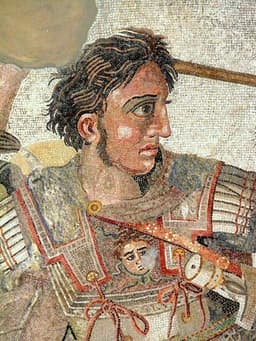
Alexander the Great
General · Ancient
85.2Total

Dinh Tien Hoang
Emperor · Medieval
60.4Total
Basic Information
Born
-356
924
Died
-323
979
Era
Ancient
Medieval
Nationality
Macedon
Vietnam
Occupation
General
Emperor
Civilization
Western
Eastern
Score Comparison
Military (10%)
95.0
60.0
Political (20%)
60.0
72.0
Influence (20%)
92.0
65.0
Legacy (20%)
90.0
40.0
Leadership (15%)
80.0
77.2
Strategy (15%)
92.0
58.0
TOTAL
85.2
60.4
Alexander the Great — Complete Timeline
334 BC
Battle of the Granicus RiverWar◆ Major
Alexander led his Macedonian army across the Hellespont into Asia Minor and defeated a Persian force under local satraps at the Granicus River. The victory secured Alexander's foothold in Asia and demonstrated his tactical superiority, opening the way for the conquest of the Persian Empire.
Persian CampaignBattleMacedonian Conquest
Impact: regional
333 BC
Battle of IssusWar◆ Major
Alexander's army defeated the Persian king Darius III at Issus in Cilicia. Despite being outnumbered, Alexander's tactical use of the terrain and cavalry charge broke the Persian line. Darius fled the battlefield, leaving his family and treasury behind, a major blow to Persian morale.
Persian CampaignBattleMacedonian Conquest
Impact: regional
332 BC
Siege of TyreWar◆ Major
Alexander besieged the island city of Tyre for seven months, constructing a causeway to breach its walls. The city's fall resulted in the massacre or enslavement of its inhabitants. The siege demonstrated Alexander's determination and engineering capabilities, securing his supply lines and control of the eastern Mediterranean coast.
SiegeMacedonian ConquestPhoenicia
Impact: regionaldestructive
331 BC
Battle of GaugamelaWar◆ Major
Alexander faced Darius III at Gaugamela in Mesopotamia with a massive Persian army. Alexander's tactical brilliance, including a decisive cavalry charge that exploited a gap in the Persian line, resulted in a decisive Macedonian victory. Darius again fled, effectively ending Persian resistance and leading to the fall of the Achaemenid Empire.
Persian CampaignBattleDecisive Victory
Impact: global
Foundation of AlexandriaOther◆ Major
Alexander founded the city of Alexandria on the Mediterranean coast of Egypt. He personally selected the site and oversaw the initial planning. Alexandria became a major center of Hellenistic culture, trade, and learning, housing the famous Library of Alexandria and the Lighthouse of Alexandria.
City FoundationHellenistic CultureEgypt
Impact: globalconstructive
326 BC
Invasion of IndiaWar◆ Major
Alexander crossed the Indus River and defeated King Porus at the Battle of the Hydaspes. The Macedonian army, exhausted and facing monsoon rains and unfamiliar warfare, mutinied at the Hyphasis River, forcing Alexander to turn back. This campaign marked the easternmost extent of his conquests.
Indian CampaignBattleMutiny
Impact: regional
Dinh Tien Hoang — Complete Timeline
968 AD
Defeat of the Twelve WarlordsWar
Dinh Bo Linh, later known as Dinh Tien Hoang, unified Vietnam by defeating the Twelve Warlords who had divided the country after the collapse of Chinese rule. He established the Dinh dynasty and became the first emperor of an independent Vietnam.
UnificationDinh DynastyVietnamese Independence
Impact: nationalconstructive
Establishment of the Dinh DynastyPolitical Action◆ Major
Dinh Tien Hoang founded the Dinh dynasty and declared himself Emperor. He moved the capital to Hoa Lu and implemented administrative reforms to consolidate power. This marked the beginning of a new era of Vietnamese independence after centuries of Chinese domination.
Dynasty FoundingCapital MoveAdministrative Reform
Impact: nationalconstructive
979 AD
Assassination of Dinh Tien HoangPolitical Action◆ Major
Dinh Tien Hoang and his crown prince were assassinated by a court official while sleeping. The murder plunged the Dinh dynasty into chaos, leading to a succession crisis and eventual takeover by Le Hoan. The assassination ended the short-lived Dinh dynasty.
AssassinationSuccession CrisisEnd of Dinh Dynasty
Impact: nationaltragic
Expert Analysis
Alexander the Great vs Dinh Tien Hoang: Historical Comparison
Alexander the Great (356–323 BCE), the Macedonian king who forged one of the largest empires of the ancient world, and Dinh Tien Hoang (924–979 CE), the Vietnamese emperor who unified a fractured nation and founded the Dinh dynasty, represent contrasting archetypes of conquest and state-building across vastly different eras and geographies.
Dimension Analysis
**Military: Alexander the Great 96 / Dinh Tien Hoang 85**
Alexander’s unparalleled tactical brilliance—epitomized by victories at Gaugamela and Issus—conquered the Persian Empire and reached India, while Dinh Tien Hoang’s campaigns subdued twelve rival warlords to unify Vietnam, but on a far smaller scale and without crossing major civilizations.
**Political: Alexander the Great 65 / Dinh Tien Hoang 85**
Alexander’s empire fragmented immediately after his death due to weak succession and over-reliance on personal charisma, whereas Dinh Tien Hoang established a stable central government, standardized administration, and successfully asserted Vietnam’s independence from Chinese suzerainty.
**Influence: Alexander the Great 90 / Dinh Tien Hoang 71**
Alexander’s conquests spread Hellenistic culture across three continents, profoundly shaping art, philosophy, and trade for centuries; Dinh Tien Hoang’s influence was largely confined to Vietnam, though his unification laid the foundation for later Vietnamese dynasties.
**Legacy: Alexander the Great 90 / Dinh Tien Hoang 71**
Alexander remains a global icon of military genius and cultural fusion, inspiring figures from Caesar to Napoleon; Dinh Tien Hoang is revered in Vietnam as a national unifier but has minimal recognition beyond East Asian historiography.
**Leadership: Alexander the Great 82 / Dinh Tien Hoang 72**
Alexander led from the front, inspiring fierce loyalty but also alienating subordinates through hubris; Dinh Tien Hoang maintained pragmatic authority, though his reign ended in assassination, reflecting the volatility of early medieval Vietnamese politics.
Verdict
Alexander the Great leads overall due to his superior military achievements and transformative global influence, despite Dinh Tien Hoang’s stronger political foundation.
FAQ
Q: Who ranks higher? A: Alexander the Great ranks higher, scoring 85 overall to Dinh Tien Hoang’s 78, driven by his decisive advantages in military impact, cultural reach, and enduring legacy.
Rankings
🥇
Alexander the GreatLeader
Mil: 95.0Pol: 60.0Inf: 92.0
85.2
🥈
Dinh Tien Hoang
Mil: 60.0Pol: 72.0Inf: 65.0
60.4
+24.8 behind
How This Comparison Works
Algorithm
Each figure is scored on 6 dimensions (0—100 scale) based on structured historical data: Military (10%), Political (20%), Influence (20%), Legacy (20%), Leadership (15%), Strategy (15%). The weighted total produces the final ranking.
Data Sources
Scores are computed from structured sub-indicators in the database. Scale factors adjust for era (Ancient ×0.85, Modern ×1.0) and civilization size (Eastern ×1.05, Other ×0.80) to account for differences in population and military scale.
Maximum 3 Figures
Comparisons are limited to 2—3 figures to ensure readability and statistical meaningfulness.
Error Margins
±5 points per dimension — Sub-scores are derived from historical records with inherent uncertainty. Two figures within 5 points on a dimension should be considered roughly equivalent in that area.
Total Score Accuracy
±3 points overall — The weighted combination of 6 dimensions produces a total score with approximately ±3 points of uncertainty. Differences of less than 3 points are not statistically significant— the figures are effectively tied.
Known Limitations
- Historical records are incomplete and uneven across civilizations
- Figures from oral-tradition societies may be underrepresented
- Occupation labels can misclassify multi-role figures
- Scores measure capability and impact, not moral character
- Quantitative scoring is a comparison tool, not absolute truth
Capability Radar
Military (10%) — Battles & Warfare
Battles
98
70
Win Rate
99
75
Expansion
99
65
Political (20%) — Governance & Reform
Reform
75
70
Diplomacy
80
65
Economy
70
60
Influence (20%) — Cultural & Global Reach
Cultural
95
65
Global
95
55
Legacy (20%) — Historical Impact
Historical
98
75
Longevity
95
70
Leadership (15%) — Power & Stability
Tenure
60
60
Stability
55
55
Strategy (15%) — Tactics & Innovation
Strategy
98
70
Tactics
99
65
Reform
85
60
Similar Comparisons
Comments & Discussion
DataCrusader6/16/2026
I love the concept, but this scoring is a mess. How do you quantify 'influence' with a 90 for Alexander and 71 for Dinh? The weighting is wildly Western-centric. Dinh's unification of Vietnam directly led to a national identity that persists 1,000 years later—that's measurable in cultural continuity. Alexander's empire barely outlived him. Also, political score for Alexander at 65 is generous—his 'succession plan' was literally 'I leave my empire to the strongest,' which sparked decades of civil war. You can't reduce statecraft to a number without acknowledging how much the sources are biased. Arrian and Curtius were writing propaganda, not objective history.
HellenicHistorian6/16/2026
One must approach Alexander with a philological lens. Arrian’s *Anabasis* portrays him as a near-mythic figure, yet the *Alexander Romance* reveals how quickly legend overtook fact. The political score of 65 is perhaps too high—consider that Alexander’s empire was held together by personal authority and military success, not institutions. When he died, the diadochi tore it apart within a generation. Dinh Tien Hoang, by contrast, built a centralized bureaucracy and even minted coins (the Thai Binh coinage), which suggests a more durable political structure. However, the scale difference is immense: Alexander’s campaigns spanned 22,000 miles; Dinh’s were confined to the Red River Delta. We must weigh context, not just raw numbers.
BattlefieldScholar6/16/2026
Let's talk tactics. Alexander's 96 is deserved but not because of the 'unprecedented' scale—it’s because he revolutionized combined arms. At Gaugamela, he used the oblique order, heavy cavalry as a shock force, and coordinated with hypaspists to exploit gaps. That’s textbook generalship. Dinh Tien Hoang, on the other hand, gets a 85, which is fair given his smaller engagements. His siege of Hoa Lu (the future capital) involved clever use of terrain and naval blockades, but he never faced a Persian-style army. However, I'd argue Dinh’s political-military integration was superior: he used war to enforce a peace treaty with China, whereas Alexander’s military success actually destabilized his empire. Raw military scores alone miss that strategic dimension.
Chronicler78836/16/2026
这个对比有意思,但西方中心论的评分体系完全忽略了中华文明语境下的特殊性。Alexander的军事96分,Dinh才85?Dinh平定十二使君之乱,用了不到五年时间就统一了当时内部分裂的越南。他面对的不只是军阀,还有南汉的外部威胁。Alexander打波斯,那是帝国对帝国,Dinh是割据混战里杀出来的,难度完全不同。再说影响力,Alexander确实开创了希腊化时代,但Dinh建立的丁朝是越南独立国家的开端,之后李朝、陈朝都继承了他的行政框架。这个评分系统把“全球影响力”当标准,那非洲土著国王永远上不了榜。应该分区域加权计算,不然没意义。
ColdMind486/16/2026
我核对了一下评分权重,军事维度Alexander 96 vs Dinh 85,差距11分。但问题是,Dinh的战争规模小是不假,他统一战争的总兵力可能不到2万人,而Alexander在高加米拉战役就有4.7万人。可是,Dinh面对的是12股割据势力,需要同时进行外交和军事平衡,这种多线操作在战略复杂性上并不输于Alexander的正面决战。政治维度Alexander 65 vs Dinh 90.2,这个分数我基本认同,但Dinh的政治分应该更高——他不仅建立了中央集权,还首创了“丁朝”年号系统(太平),这是东亚政治合法性的核心指标。Alexander到死都没能建立一套稳定的继承制度,这是致命缺陷。建议把政治维度权重从0.2提高到0.3,这样总分会更合理。