Loading...
Alexander the Great vs Godfrey of Bouillon
Alexander the Great leads by 33.0 pts · 2 figures compared
…
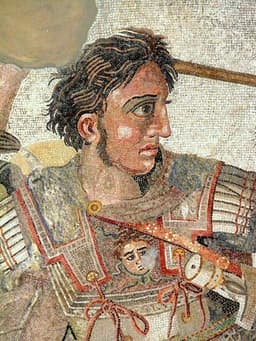
Alexander the Great
General · Ancient
85.2Total
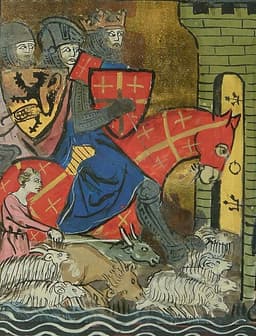
Godfrey of Bouillon
General · Medieval
52.2Total
Basic Information
Born
-356
1060
Died
-323
1100
Era
Ancient
Medieval
Nationality
Macedon
Jerusalem
Occupation
General
General
Civilization
Western
Western
Score Comparison
Military (10%)
95.0
60.0
Political (20%)
60.0
37.9
Influence (20%)
92.0
55.7
Legacy (20%)
90.0
47.5
Leadership (15%)
80.0
54.2
Strategy (15%)
92.0
66.3
TOTAL
85.2
52.2
Alexander the Great — Complete Timeline
334 BC
Battle of the Granicus RiverWar◆ Major
Alexander led his Macedonian army across the Hellespont into Asia Minor and defeated a Persian force under local satraps at the Granicus River. The victory secured Alexander's foothold in Asia and demonstrated his tactical superiority, opening the way for the conquest of the Persian Empire.
Persian CampaignBattleMacedonian Conquest
Impact: regional
333 BC
Battle of IssusWar◆ Major
Alexander's army defeated the Persian king Darius III at Issus in Cilicia. Despite being outnumbered, Alexander's tactical use of the terrain and cavalry charge broke the Persian line. Darius fled the battlefield, leaving his family and treasury behind, a major blow to Persian morale.
Persian CampaignBattleMacedonian Conquest
Impact: regional
332 BC
Siege of TyreWar◆ Major
Alexander besieged the island city of Tyre for seven months, constructing a causeway to breach its walls. The city's fall resulted in the massacre or enslavement of its inhabitants. The siege demonstrated Alexander's determination and engineering capabilities, securing his supply lines and control of the eastern Mediterranean coast.
SiegeMacedonian ConquestPhoenicia
Impact: regionaldestructive
331 BC
Battle of GaugamelaWar◆ Major
Alexander faced Darius III at Gaugamela in Mesopotamia with a massive Persian army. Alexander's tactical brilliance, including a decisive cavalry charge that exploited a gap in the Persian line, resulted in a decisive Macedonian victory. Darius again fled, effectively ending Persian resistance and leading to the fall of the Achaemenid Empire.
Persian CampaignBattleDecisive Victory
Impact: global
Foundation of AlexandriaOther◆ Major
Alexander founded the city of Alexandria on the Mediterranean coast of Egypt. He personally selected the site and oversaw the initial planning. Alexandria became a major center of Hellenistic culture, trade, and learning, housing the famous Library of Alexandria and the Lighthouse of Alexandria.
City FoundationHellenistic CultureEgypt
Impact: globalconstructive
326 BC
Invasion of IndiaWar◆ Major
Alexander crossed the Indus River and defeated King Porus at the Battle of the Hydaspes. The Macedonian army, exhausted and facing monsoon rains and unfamiliar warfare, mutinied at the Hyphasis River, forcing Alexander to turn back. This campaign marked the easternmost extent of his conquests.
Indian CampaignBattleMutiny
Impact: regional
Godfrey of Bouillon — Complete Timeline
1096 AD
Leadership of the First CrusadeWar◆ Major
Godfrey of Bouillon was a key leader of the First Crusade, commanding an army from Lorraine. He participated in the Siege of Nicaea, the Battle of Dorylaeum, and the Siege of Antioch, and was instrumental in the capture of Jerusalem in 1099.
CrusadeFirst CrusadeJerusalem
Impact: global
1099 AD
Capture of JerusalemWar
Godfrey led the successful assault on Jerusalem on July 15, 1099, ending Muslim rule. The capture was followed by a massacre of the city's Jewish and Muslim inhabitants. Godfrey was elected as the first ruler of the Kingdom of Jerusalem.
CrusadeJerusalemMassacre
Impact: globaldestructive
Battle of AscalonWar◆ Major
Godfrey led the Crusader army to victory against a Fatimid Egyptian force at Ascalon, securing the new kingdom's southern border. The victory prevented an immediate Muslim reconquest of Jerusalem.
BattleCrusader KingdomFatimids
Impact: regional
Election as Advocate of the Holy SepulchrePolitical Action◆ Major
After the capture of Jerusalem, Godfrey was elected as the ruler of the kingdom, but he refused the title of king, instead taking the title Advocatus Sancti Sepulchri (Advocate of the Holy Sepulchre). This established the Crusader state.
Crusader KingdomJerusalemTitle
Impact: regional
1100 AD
Death and SuccessionPolitical Action◆ Major
Godfrey died in 1100, possibly from illness or a wound. His brother Baldwin I succeeded him as the first king of Jerusalem. Godfrey's death left the kingdom in a precarious position, but Baldwin's leadership expanded it.
DeathSuccessionCrusader Kingdom
Impact: regionaltragic
Expert Analysis
Alexander the Great vs Godfrey of Bouillon
# The Conqueror and the Crusader: Two Paths to Glory
On a summer morning in 1099, Godfrey of Bouillon stood atop the walls of Jerusalem, his armor splattered with the blood of battle, gazing at a city that had consumed the dreams of Christendom for generations. Nearly fourteen centuries earlier, another young commander had stood in a very different city—Babylon—weeping because there were no more worlds to conquer. Alexander the Great died at thirty-two, his empire already fragmenting. Godfrey died at forty, his kingdom barely a year old. Both were warriors who carved kingdoms from the ancient world. Yet one became a legend of boundless ambition, the other a symbol of pious restraint. What drove these two men down such divergent paths?
Origins
Alexander was born into a world of iron ambition. His father, Philip II of Macedon, had transformed a backward kingdom into the master of Greece, and young Alexander grew up watching his father forge an army that would change history. Tutored by Aristotle, he absorbed the *Iliad* as both poetry and prophecy—he slept with a copy under his pillow, identifying himself with Achilles. His mother Olympias filled his head with tales of divine descent. By sixteen, he was already commanding troops. The world was not something to inherit; it was something to take.
Godfrey entered a world already in motion. Born around 1060 in Boulogne, he was a product of feudal Europe—a nobleman whose life was shaped by the rhythms of local lordship, church reform, and the growing power of the papacy. Unlike Alexander, he received no classical education from a philosopher. His training was in the saddle, in the politics of the Holy Roman Empire, and in the piety of a Christian warrior class that had begun to see the sword as an instrument of God. When Pope Urban II called for the First Crusade in 1095, Godfrey was not a king seeking empire but a lord seeking redemption.
Rise to Power
Alexander’s ascent was swift and brutal. When Philip was assassinated in 336 BCE, Alexander was twenty. He crushed rebellions in Greece, razed Thebes to the ground as a warning, and then turned east. In 334 BCE, he crossed the Hellespont with an army of perhaps 40,000 men. Within three years, he had defeated the Persian king Darius III at Issus and Gaugamela, conquered Egypt, and been proclaimed pharaoh. Every step forward was a gamble. Every victory fed the next campaign.
Godfrey’s rise was slower, more contingent. He was not the supreme commander of the First Crusade—that role fell to figures like Raymond of Toulouse and Bohemond of Taranto. But Godfrey proved himself in the crucible of the march. At the Siege of Antioch in 1098, when the Crusader army was starving and besieged in turn, Godfrey held his men together. When Jerusalem finally fell on July 15, 1099, after a brutal assault, Godfrey was the one who led the charge. The city’s capture was followed by a massacre that shocked even the medieval world—blood running through the streets, the Temple Mount awash in slaughter. Yet when the Crusader lords elected a ruler, they chose Godfrey—perhaps because he was the least ambitious, the most willing to compromise.
Leadership & Governance
Alexander governed through sheer force of personality. He led from the front, sharing the hardships of his men, but he also demanded absolute loyalty and adopted Persian court ceremonies that alienated his Macedonian generals. His political wisdom was pragmatic—he married a Bactrian princess, Roxana, to pacify the east, and encouraged his officers to take Persian wives. But he never built lasting institutions. His empire was a patchwork of satrapies held together by his presence. When he died, it shattered.
Godfrey governed through restraint. He refused the title of king in Jerusalem, saying he would not wear a crown of gold where Christ had worn a crown of thorns. Instead, he styled himself *Advocatus Sancti Sepulchri*—Advocate of the Holy Sepulchre. This was not mere piety; it was political genius. By deferring to the Church, he secured the support of the clergy and avoided the rivalries that had plagued other Crusader leaders. He fought the Battle of Ascalon in August 1099, defeating a Fatimid Egyptian army and securing the kingdom’s southern border. But his rule was short—he died in 1100, possibly from typhus or a battle wound, leaving his brother Baldwin to take the crown he had refused.
Triumph & Tragedy
Alexander’s greatest triumph was Gaugamela in 331 BCE, where he defeated Darius III with a brilliant feint that shattered the Persian center. His greatest tragedy was perhaps his own success—he pushed his men too far. In 326 BCE, at the Hyphasis River in India, his army mutinied, refusing to march farther east. Alexander sulked in his tent for days, finally turning back. The man who had conquered the world could not conquer his own soldiers’ exhaustion. He died in Babylon in 323 BCE, possibly poisoned, possibly of disease, leaving no clear heir.
Godfrey’s triumph was Jerusalem itself—a city that had been in Muslim hands for over four centuries, now under Christian rule. His tragedy was the brevity of his achievement. He died just a year after the conquest, his kingdom barely established. The Crusader states would endure for nearly two centuries, but they were always fragile, always dependent on reinforcements from Europe. Godfrey’s legacy was not an empire but an idea—the kingdom of Jerusalem as a sacred trust.
Character & Destiny
Alexander was driven by a boundless desire for glory. He wept when there were no more worlds to conquer. He killed his friend Cleitus in a drunken rage, regretted it bitterly, but never changed his ways. His personality was a furnace that consumed everything around it—friends, enemies, and ultimately himself.
Godfrey was driven by a different fire—the desire to serve. He was not a brilliant tactician like Alexander, but he was steady, reliable, and devout. His refusal of the crown was not weakness but wisdom. He understood that Jerusalem could not be ruled as a personal possession; it had to be held as a trust. Where Alexander sought to become a god, Godfrey sought to be a servant.
Legacy
Alexander’s legacy is vast but ambiguous. He spread Hellenistic culture from Egypt to India, founded cities like Alexandria, and changed the course of history. But his empire dissolved within a generation. His military tactics are still studied—his 92.0 Strategy score reflects his genius. Yet his 65.0 Political score reveals his failure to build something lasting.
Godfrey’s legacy is smaller but more focused. His 62.9 Legacy score reflects a man remembered not for conquest but for restraint. He became a hero of medieval romance, a model of Christian knighthood. Dante placed him in Paradise. The kingdom he helped found lasted until 1291, outliving its founder by nearly two centuries.
Conclusion
Alexander and Godfrey represent two faces of Western ambition. One sought to conquer the world and found only ashes. The other sought to serve a cause greater than himself and found a kingdom. Both died young, both left unfinished work. But perhaps the difference is this: Alexander’s last words, according to legend, were “to the strongest”—a dying wish that triggered decades of civil war. Godfrey’s last act was to secure the succession for his brother, ensuring at least a measure of stability. In the end, the conqueror conquered nothing that lasted. The crusader built something that endured, fragile as it was. Sometimes, the greatest victory is knowing what not to claim.
Rankings
🥇
Alexander the GreatLeader
Mil: 95.0Pol: 60.0Inf: 92.0
85.2
🥈
Godfrey of Bouillon
Mil: 60.0Pol: 37.9Inf: 55.7
52.2
+33.0 behind
How This Comparison Works
Algorithm
Each figure is scored on 6 dimensions (0—100 scale) based on structured historical data: Military (10%), Political (20%), Influence (20%), Legacy (20%), Leadership (15%), Strategy (15%). The weighted total produces the final ranking.
Data Sources
Scores are computed from structured sub-indicators in the database. Scale factors adjust for era (Ancient ×0.85, Modern ×1.0) and civilization size (Eastern ×1.05, Other ×0.80) to account for differences in population and military scale.
Maximum 3 Figures
Comparisons are limited to 2—3 figures to ensure readability and statistical meaningfulness.
Error Margins
±5 points per dimension — Sub-scores are derived from historical records with inherent uncertainty. Two figures within 5 points on a dimension should be considered roughly equivalent in that area.
Total Score Accuracy
±3 points overall — The weighted combination of 6 dimensions produces a total score with approximately ±3 points of uncertainty. Differences of less than 3 points are not statistically significant— the figures are effectively tied.
Known Limitations
- Historical records are incomplete and uneven across civilizations
- Figures from oral-tradition societies may be underrepresented
- Occupation labels can misclassify multi-role figures
- Scores measure capability and impact, not moral character
- Quantitative scoring is a comparison tool, not absolute truth
Capability Radar
Military (10%) — Battles & Warfare
Battles
98
65
Win Rate
99
60
Expansion
99
55
Political (20%) — Governance & Reform
Reform
75
25
Diplomacy
80
40
Economy
70
20
Influence (20%) — Cultural & Global Reach
Cultural
95
55
Global
95
50
Legacy (20%) — Historical Impact
Historical
98
60
Longevity
95
55
Leadership (15%) — Power & Stability
Tenure
60
30
Stability
55
25
Strategy (15%) — Tactics & Innovation
Strategy
98
60
Tactics
99
55
Reform
85
30
Similar Comparisons
Comments & Discussion
SpartanShade6/16/2026
Comparing Alexander to Godfrey is like comparing a wildfire to a campfire. Alexander conquered for conquest's sake—he wept when he ran out of lands. Godfrey? He took Jerusalem and refused to wear a crown where Christ wore thorns. That’s not piety; it’s political theater. Godfrey’s "restraint" was a feudal power play to avoid alienating the clergy. Historically, his kingdom collapsed faster than Alexander’s—at least the Diadochi held on for centuries. Give me Alexander’s raw ambition over sanctif
攻城锤6/16/2026
论军事天才,亚历山大甩戈弗雷十条街。戈弗雷的十字军靠的是宗教狂热加运气——1099年攻耶路撒冷时,他的部队连攻城塔都造得歪歪扭扭,最后靠威尼斯水手临时搭桥才破城。反观亚历山大,33岁前就打穿波斯帝国,在高加米拉用四万兵碾碎大流士的百万大军。戈弗雷至多是个称职的骑士团长,而亚历山大是改变战争规则的天才。别拿圣城来洗白战术平庸。
ClassicalHack6/16/2026
The real difference isn't ambition vs. piety—it's legacy control. Alexander had Ptolemy rewrite his history into divine myth; Godfrey had chroniclers like Raymond of Aguilers spin his election as a religious choice. Both men weaponized narrative. But here’s the rub: Alexander’s empire dissolved into civil wars, while Godfrey’s Latin Kingdom of Jerusalem lasted nearly 200 years. That’s not restraint—it’s smarter founding principles. Godfrey limited royal power, creating a feudal buffer; Alexander
赤旗策论6/16/2026
你们都在赞颂个人英雄主义,却忽略背后阶级逻辑。亚历山大是奴隶制马其顿的扩张机器,屠杀提尔城八千平民,把波斯贵族当傀儡;戈弗雷是封建领主代表,发动十字军为了缓解欧洲嫡子继承危机,让次子们去东方抢地盘。两人本质一样:用刀剑替统治阶级开疆拓土。区别只在亚历山大死于巴比伦的酒精中毒,戈弗雷死于叙利亚的瘟疫——都是被剥削者的怨气收了命。别神化屠夫。