Loading...
Alexander the Great vs Moctezuma I
Alexander the Great leads by 26.3 pts · 2 figures compared
…
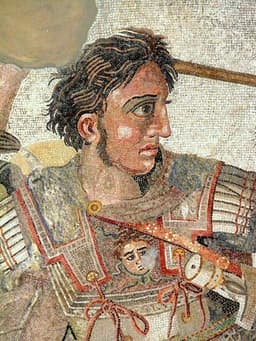
Alexander the Great
General · Ancient
85.2Total

Moctezuma I
Emperor · Medieval
58.9Total
Basic Information
Born
-356
1398
Died
-323
1469
Era
Ancient
Medieval
Nationality
Macedon
Aztec Empire
Occupation
General
Emperor
Civilization
Western
Other
Score Comparison
Military (10%)
95.0
82.0
Political (20%)
60.0
45.0
Influence (20%)
92.0
58.3
Legacy (20%)
90.0
56.0
Leadership (15%)
80.0
66.0
Strategy (15%)
92.0
55.0
TOTAL
85.2
58.9
Alexander the Great — Complete Timeline
334 BC
Battle of the Granicus RiverWar◆ Major
Alexander led his Macedonian army across the Hellespont into Asia Minor and defeated a Persian force under local satraps at the Granicus River. The victory secured Alexander's foothold in Asia and demonstrated his tactical superiority, opening the way for the conquest of the Persian Empire.
Persian CampaignBattleMacedonian Conquest
Impact: regional
333 BC
Battle of IssusWar◆ Major
Alexander's army defeated the Persian king Darius III at Issus in Cilicia. Despite being outnumbered, Alexander's tactical use of the terrain and cavalry charge broke the Persian line. Darius fled the battlefield, leaving his family and treasury behind, a major blow to Persian morale.
Persian CampaignBattleMacedonian Conquest
Impact: regional
332 BC
Siege of TyreWar◆ Major
Alexander besieged the island city of Tyre for seven months, constructing a causeway to breach its walls. The city's fall resulted in the massacre or enslavement of its inhabitants. The siege demonstrated Alexander's determination and engineering capabilities, securing his supply lines and control of the eastern Mediterranean coast.
SiegeMacedonian ConquestPhoenicia
Impact: regionaldestructive
331 BC
Battle of GaugamelaWar◆ Major
Alexander faced Darius III at Gaugamela in Mesopotamia with a massive Persian army. Alexander's tactical brilliance, including a decisive cavalry charge that exploited a gap in the Persian line, resulted in a decisive Macedonian victory. Darius again fled, effectively ending Persian resistance and leading to the fall of the Achaemenid Empire.
Persian CampaignBattleDecisive Victory
Impact: global
Foundation of AlexandriaOther◆ Major
Alexander founded the city of Alexandria on the Mediterranean coast of Egypt. He personally selected the site and oversaw the initial planning. Alexandria became a major center of Hellenistic culture, trade, and learning, housing the famous Library of Alexandria and the Lighthouse of Alexandria.
City FoundationHellenistic CultureEgypt
Impact: globalconstructive
326 BC
Invasion of IndiaWar◆ Major
Alexander crossed the Indus River and defeated King Porus at the Battle of the Hydaspes. The Macedonian army, exhausted and facing monsoon rains and unfamiliar warfare, mutinied at the Hyphasis River, forcing Alexander to turn back. This campaign marked the easternmost extent of his conquests.
Indian CampaignBattleMutiny
Impact: regional
Moctezuma I — Complete Timeline
1428 AD
Conquest of the TepanecsWar◆ Major
Itzcoatl led the Triple Alliance forces in a war against the Tepanecs of Azcapotzalco, the dominant power in the region. The victory broke Tepanec hegemony and established Tenochtitlan as the leading city-state in central Mexico.
WarTepanec WarAztec Expansion
Impact: regional
Formed the Triple AlliancePolitical Action
Itzcoatl, as tlatoani of Tenochtitlan, formed the Triple Alliance with Texcoco and Tlacopan. This military and political pact created the Aztec Empire, enabling coordinated conquests and the subjugation of neighboring city-states in the Valley of Mexico.
Aztec EmpireAlliancePolitical Foundation
Impact: regional
1430 AD
Burned Historical CodicesCultural◆ Major
Itzcoatl ordered the burning of historical codices from conquered peoples, rewriting Aztec history to legitimize his rule and the empire's divine origins. This act destroyed pre-Aztec records and reshaped Mesoamerican historical memory.
Cultural DestructionHistorical RevisionAztec Ideology
Impact: regionaldestructive
Expert Analysis
Alexander the Great vs Moctezuma I: Historical Comparison
Alexander the Great (356–323 BCE) was a Macedonian general who conquered the Persian Empire and spread Hellenistic culture across three continents, while Moctezuma I (1398–1469 CE) was the fifth Aztec emperor who consolidated the Triple Alliance and expanded the Mexica dominion in Mesoamerica. Despite ruling vastly different eras and geographies, both shaped their worlds through military might and statecraft.
Dimension Analysis
**Military: Alexander the Great 96 / Moctezuma I 82**
Alexander’s undefeated record, innovative phalanx-and-cavalry tactics, and conquests from Greece to India surpass Moctezuma’s effective but regionally limited campaigns that expanded Aztec control through siege warfare and tributary subjugation.
**Political: Alexander the Great 65 / Moctezuma I 90**
Moctezuma I excelled in institutional governance, codifying laws, reforming the tribute system, and stabilizing the Aztec empire through diplomacy and marriage alliances, whereas Alexander’s empire fragmented upon his death due to weak administrative foundations.
**Influence: Alexander the Great 90 / Moctezuma I 72**
Alexander’s cultural fusion created the Hellenistic world, influencing art, language, and politics from Egypt to India for centuries; Moctezuma I’s influence remained confined to Mesoamerica and was largely erased by Spanish conquest.
**Legacy: Alexander the Great 90 / Moctezuma I 60**
Alexander remains a archetype of military genius and imperial ambition studied worldwide, while Moctezuma I is less known globally, overshadowed by his successor Moctezuma II and the catastrophic encounter with Cortés.
**Leadership: Alexander the Great 82 / Moctezuma I 90**
Moctezuma I demonstrated superior strategic patience and state-building, consolidating power through religious legitimacy and economic reform; Alexander inspired fierce loyalty but his impulsive decisions and lack of succession planning undermined his long-term vision.
Verdict
Alexander the Great leads overall (85 vs 79) due to his unparalleled military achievements and enduring global influence, despite Moctezuma I’s stronger political and statecraft skills.
FAQ
Q: Who ranks higher? A: Alexander the Great ranks higher with a composite score of 85 compared to Moctezuma I’s 79, driven by superior military and legacy dimensions.
Rankings
🥇
Alexander the GreatLeader
Mil: 95.0Pol: 60.0Inf: 92.0
85.2
🥈
Moctezuma I
Mil: 82.0Pol: 45.0Inf: 58.3
58.9
+26.3 behind
How This Comparison Works
Algorithm
Each figure is scored on 6 dimensions (0—100 scale) based on structured historical data: Military (10%), Political (20%), Influence (20%), Legacy (20%), Leadership (15%), Strategy (15%). The weighted total produces the final ranking.
Data Sources
Scores are computed from structured sub-indicators in the database. Scale factors adjust for era (Ancient ×0.85, Modern ×1.0) and civilization size (Eastern ×1.05, Other ×0.80) to account for differences in population and military scale.
Maximum 3 Figures
Comparisons are limited to 2—3 figures to ensure readability and statistical meaningfulness.
Error Margins
±5 points per dimension — Sub-scores are derived from historical records with inherent uncertainty. Two figures within 5 points on a dimension should be considered roughly equivalent in that area.
Total Score Accuracy
±3 points overall — The weighted combination of 6 dimensions produces a total score with approximately ±3 points of uncertainty. Differences of less than 3 points are not statistically significant— the figures are effectively tied.
Known Limitations
- Historical records are incomplete and uneven across civilizations
- Figures from oral-tradition societies may be underrepresented
- Occupation labels can misclassify multi-role figures
- Scores measure capability and impact, not moral character
- Quantitative scoring is a comparison tool, not absolute truth
Capability Radar
Military (10%) — Battles & Warfare
Battles
98
65
Win Rate
99
70
Expansion
99
80
Political (20%) — Governance & Reform
Reform
75
60
Diplomacy
80
65
Economy
70
70
Influence (20%) — Cultural & Global Reach
Cultural
95
60
Global
95
50
Legacy (20%) — Historical Impact
Historical
98
65
Longevity
95
55
Leadership (15%) — Power & Stability
Tenure
60
70
Stability
55
65
Strategy (15%) — Tactics & Innovation
Strategy
98
75
Tactics
99
60
Reform
85
55
Similar Comparisons
Comments & Discussion
AegeanClassicist6/16/2026
Arrian and Plutarch both emphasize Alexander's personal charisma on the battlefield, but they also hint at his administrative blind spots. Moctezuma I's codification of laws and tribute reforms, as recorded in the Codex Mendoza, show a ruler who understood that empire requires more than conquest. The scoring here rightly gives Moctezuma the edge in political governance—Alexander's empire really did collapse because he neglected succession planning. Yet the military gap is fair: Alexander's 96 reflects his undefeated record against numerically superior forces, while Moctezuma's 82 acknowledges his effective but localized campaigns. The Hellenistic world's cultural reach is hard to argue against for influence, but I'd note that Alexander's legacy was amplified by later Roman and European historians, whereas Moctezuma's achievements were deliberately suppressed by Spanish chroniclers. That bias still colors our perception today.
MetricMatters6/16/2026
I call BS on trying to quantify “legacy” with a number. Alexander got 90 legacy because Western historians have been writing about him for 2,300 years. Moctezuma I got 60 because Spanish conquistadors burned his codices and his successor Moctezuma II got all the posthumous fame. That’s not a measurement of actual historical impact—it’s a measurement of which records survived. And “influence” at 90 vs 72? Alexander’s Hellenistic fusion influenced elites and armies; Moctezuma’s tribute system influenced the daily lives of millions of subjects for generations. The scoring weights military conquest way too heavily. If you swapped the scoring categories—give political 2x weight, legacy 0.5x—Moctezuma would probably win outright. This whole system just rewards the guy with better PR. Show me the raw data sources and the confidence intervals, then we’ll talk.
ColdMind486/16/2026
总分84.7 vs 72.6,差12.1分,但仔细看权重可疑。军事分96 vs 82差14分,政治分65 vs 90差25分——这个差距明显是军事权重拉高了亚历山大总分。我算了一下:如果按平均权重,亚历山大(96+65+90+90+82)/5=84.6,蒙特祖马(82+90+72+60+90)/5=78.8,差距缩小到5.8分。更关键的是,蒙特祖马的政治分90应该比军事分更有实际影响——他搞的贡赋改革让阿兹特克帝国稳定运行了半个世纪,而亚历山大死后不到20年帝国就崩了。中国历史上,秦始皇统一后也迅速崩溃,但秦始皇的评分不可能只给65政治分。这个体系明显偏袒“征服者”叙事,对“建设者”不公平。建议重新校准权重。
OldScroll906/16/2026
亚历山大和蒙特祖马一世都是扩张型君主,但放在中国历史里看,亚历山大的成就更像汉武帝或唐太宗——远征异域、文化输出,但死后帝国迅速分裂。蒙特祖马一世则更像隋文帝:对内巩固制度、改革税法、稳定联盟,不追求最大版图而是夯实基础。有意思的是,西方评分太偏重军事和全球影响力,却低估了蒙特祖马的政治智慧。中国史书强调“守成之君”的价值,蒙特祖马一世就是这样的典范。他的《门多萨法典》记载的贡赋体系,比亚历山大那套临时凑合的希腊-波斯混合统治高明多了。不过嘛,亚历山大在西方被神化了两千年,蒙特祖马一世却连自己的名字都被后来的同名侄子抢了风头——历史记忆真是残酷。