Loading...
Alexander the Great vs Nyatsimba Mutota
Alexander the Great leads by 28.7 pts · 2 figures compared
…
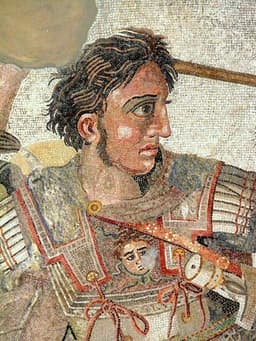
Alexander the Great
General · Ancient
85.2Total

Nyatsimba Mutota
Emperor · Medieval
56.5Total
Basic Information
Born
-356
1400
Died
-323
1450
Era
Ancient
Medieval
Nationality
Macedon
Mozambique
Occupation
General
Emperor
Civilization
Western
Other
Score Comparison
Military (10%)
95.0
72.5
Political (20%)
60.0
68.0
Influence (20%)
92.0
59.0
Legacy (20%)
90.0
50.0
Leadership (15%)
80.0
40.0
Strategy (15%)
92.0
57.5
TOTAL
85.2
56.5
Alexander the Great — Complete Timeline
334 BC
Battle of the Granicus RiverWar◆ Major
Alexander led his Macedonian army across the Hellespont into Asia Minor and defeated a Persian force under local satraps at the Granicus River. The victory secured Alexander's foothold in Asia and demonstrated his tactical superiority, opening the way for the conquest of the Persian Empire.
Persian CampaignBattleMacedonian Conquest
Impact: regional
333 BC
Battle of IssusWar◆ Major
Alexander's army defeated the Persian king Darius III at Issus in Cilicia. Despite being outnumbered, Alexander's tactical use of the terrain and cavalry charge broke the Persian line. Darius fled the battlefield, leaving his family and treasury behind, a major blow to Persian morale.
Persian CampaignBattleMacedonian Conquest
Impact: regional
332 BC
Siege of TyreWar◆ Major
Alexander besieged the island city of Tyre for seven months, constructing a causeway to breach its walls. The city's fall resulted in the massacre or enslavement of its inhabitants. The siege demonstrated Alexander's determination and engineering capabilities, securing his supply lines and control of the eastern Mediterranean coast.
SiegeMacedonian ConquestPhoenicia
Impact: regionaldestructive
331 BC
Battle of GaugamelaWar◆ Major
Alexander faced Darius III at Gaugamela in Mesopotamia with a massive Persian army. Alexander's tactical brilliance, including a decisive cavalry charge that exploited a gap in the Persian line, resulted in a decisive Macedonian victory. Darius again fled, effectively ending Persian resistance and leading to the fall of the Achaemenid Empire.
Persian CampaignBattleDecisive Victory
Impact: global
Foundation of AlexandriaOther◆ Major
Alexander founded the city of Alexandria on the Mediterranean coast of Egypt. He personally selected the site and oversaw the initial planning. Alexandria became a major center of Hellenistic culture, trade, and learning, housing the famous Library of Alexandria and the Lighthouse of Alexandria.
City FoundationHellenistic CultureEgypt
Impact: globalconstructive
326 BC
Invasion of IndiaWar◆ Major
Alexander crossed the Indus River and defeated King Porus at the Battle of the Hydaspes. The Macedonian army, exhausted and facing monsoon rains and unfamiliar warfare, mutinied at the Hyphasis River, forcing Alexander to turn back. This campaign marked the easternmost extent of his conquests.
Indian CampaignBattleMutiny
Impact: regional
Nyatsimba Mutota — Complete Timeline
1430 AD
Founding of the Mutapa EmpirePolitical Action
Nyatsimba Mutota led a migration north from Great Zimbabwe and founded the Mutapa Empire in the Zambezi valley. He established a new capital at Zvongombe and began territorial expansion.
Impact: regionalconstructive
1440 AD
Conquest of the TavaraWar◆ Major
Nyatsimba Mutota conquered the Tavara people in the Zambezi valley, incorporating their territory into the Mutapa Empire. This victory secured control over fertile agricultural lands and trade routes.
Impact: regional
1445 AD
Establishment of the Mwenemutapa TitlePolitical Action◆ Major
Nyatsimba Mutota adopted the title Mwenemutapa, meaning 'lord of the conquered lands,' formalizing the imperial structure. This title became hereditary and defined the ruler's authority over conquered peoples.
Impact: regionalconstructive
Expert Analysis
Alexander the Great vs Nyatsimba Mutota
**The Conqueror and the Builder: Two Visions of Empire**
On a dusty battlefield in what is now Pakistan, a young Macedonian king watched his veterans weep. They had marched from the Adriatic Sea to the Indus River, through deserts and over mountains, defeating every army that dared oppose them. Now, after eight years and 11,000 miles, his soldiers refused to go further. Alexander the Great, undefeated in battle, could only turn back. Half a world away and seventeen centuries later, another king led his people north from the stone ruins of Great Zimbabwe into the Zambezi valley. Nyatsimba Mutota sought no conquest of the known world. He sought land, security, and a new beginning. Where Alexander would die at thirty-two with an empire already crumbling, Mutota would found a dynasty that lasted four hundred years. Their stories, separated by time and space, ask the same question: What does it mean to build something that lasts?
**Origins**
Alexander was born into a world of ambition and violence. His father, Philip II, had transformed Macedon from a backward kingdom into the dominant power of Greece, forging a professional army and a unified state. Alexander’s tutor was Aristotle himself, who instilled in the prince a love of Homer, science, and the idea that Greeks were destined to rule barbarians. From childhood, Alexander believed he was exceptional, descended from Achilles on his mother’s side and from Heracles on his father’s. The world was his to take.
Nyatsimba Mutota emerged from a different kind of power. Great Zimbabwe, the stone-walled city of his ancestors, had dominated southeast African trade for centuries, its rulers controlling gold and ivory routes to the Indian Ocean. But by 1430, the city’s resources were strained, its pastures overgrazed, its population too large. Mutota was likely a prince or general who saw that survival required movement. He did not inherit a conquering army; he inherited a problem. Where Alexander was forged by privilege and philosophy, Mutota was shaped by necessity and geography.
**Rise to Power**
Alexander became king at twenty, after his father’s assassination. He moved with terrifying speed: securing Greece, crushing Thebes, then launching the invasion of Persia with 40,000 men. His first great victory at the Granicus River in 334 BCE opened Asia Minor. At Issus, he defeated the Persian king Darius III himself. At Gaugamela, he shattered the Persian Empire forever. Each battle was a masterpiece of tactics—the oblique advance, the cavalry charge at the decisive moment, the personal courage of a king who fought in the front ranks.
Mutota’s rise was quieter but no less decisive. Around 1430, he led his followers—perhaps a few thousand—north from Great Zimbabwe into the Zambezi valley. There he encountered the Tavara people, agricultural communities who had never faced a disciplined army from the stone city. By 1440, Mutota had conquered them, not through brilliant maneuvers but through superior organization and the psychological weight of his origins. He did not destroy the Tavara; he incorporated them. By 1445, he formalized his rule by adopting the title *Mwenemutapa*—“lord of the conquered lands.” The name itself reveals his priority: not glory, but control.
**Leadership & Governance**
Alexander ruled through charisma and terror. He married Persian princesses, adopted Persian court ceremonies, and tried to fuse his Macedonian and new subjects into a single elite. He founded dozens of cities named Alexandria, from Egypt to Afghanistan, planting Greek settlers and culture across Asia. But he also executed his own generals when they opposed him, murdered his closest friend in a drunken rage, and demanded that his soldiers worship him as a god. His political score of 65 reflects a ruler who could inspire loyalty but could not build institutions. His empire had no succession plan, no bureaucracy, no lasting structure beyond his own person.
Mutota governed through integration and tradition. The Mutapa Empire did not impose a foreign culture; it adapted local customs, married into local elites, and established a system of tribute that left existing communities largely intact. The *Mwenemutapa* was a sacred king, a mediator between the people and the ancestors, not a god demanding worship. His political score of 62.2 is similar to Alexander’s, but it supported a very different outcome: stability. The empire’s wealth came from gold and ivory trade with Portuguese merchants who arrived a century later, and Mutota’s successors would negotiate with Europeans for centuries, never losing their sovereignty until the late 1800s.
**Triumph & Tragedy**
Alexander’s greatest moment was the conquest of Persia, a feat unmatched in ancient history. His tragedy was that he could not stop. He marched into India, won more battles, and then watched his army mutiny on the banks of the Hyphasis River. He died in Babylon in 323 BCE, possibly poisoned, possibly from fever, at thirty-two. His generals immediately carved up his empire into warring kingdoms. Within a generation, his son was murdered, his mother executed, his legacy reduced to legend.
Mutota’s triumph was the founding of a state that outlived him by centuries. The Mutapa Empire controlled the Zambezi valley for over three hundred years, resisting Portuguese attempts at conquest, adapting to changing trade routes, and maintaining its identity. His tragedy is that we know so little of his personal story. No biographies survive. No Aristotle tutored him. He left no letters, no speeches, no precise date of death. He is remembered not as a man but as a founder, a name in a lineage.
**Character & Destiny**
Alexander was driven by *pothos*—a Greek word meaning longing, yearning, an almost spiritual desire for the unknown. He wanted to reach the ends of the earth, to see the Ocean that surrounded the world, to be remembered forever. This hunger made him brilliant and doomed him. He could not stop because stopping meant accepting limits, and he believed he had none.
Mutota was driven by *survival*. He saw Great Zimbabwe’s decline and chose movement over stagnation. He conquered not for glory but for land, not for immortality but for his people. His character was pragmatic, conservative, and patient. He built an empire that could endure without him. Where Alexander’s personality demanded that everything revolve around his genius, Mutota’s personality allowed his creation to outgrow him.
**Legacy**
Alexander’s legacy is the Hellenistic world: Greek language, art, and thought spread from Egypt to India, shaping the Roman Empire, Christianity, and the Renaissance. His military tactics are still taught at West Point and Sandhurst. But his empire died with him. Mutota’s legacy is the Shona civilization, the Zimbabwean identity, and a model of African state-building that resisted colonialism for centuries. The Mutapa Empire fell not to conquest but to internal decay and Portuguese manipulation, long after its founder was forgotten.
**Conclusion**
We remember Alexander because he was extraordinary—a comet that burned across the ancient world. We forget Mutota because he was successful—a sun that rose and set for four hundred years without need of chroniclers. One conquered the world and lost it; the other conquered a valley and kept it. Perhaps the deepest difference is not in their scores or their battles but in their relationship to time. Alexander wanted to be remembered. Mutota wanted his people to survive. History gives us both, and asks which we would choose.
Rankings
🥇
Alexander the GreatLeader
Mil: 95.0Pol: 60.0Inf: 92.0
85.2
🥈
Nyatsimba Mutota
Mil: 72.5Pol: 68.0Inf: 59.0
56.5
+28.7 behind
How This Comparison Works
Algorithm
Each figure is scored on 6 dimensions (0—100 scale) based on structured historical data: Military (10%), Political (20%), Influence (20%), Legacy (20%), Leadership (15%), Strategy (15%). The weighted total produces the final ranking.
Data Sources
Scores are computed from structured sub-indicators in the database. Scale factors adjust for era (Ancient ×0.85, Modern ×1.0) and civilization size (Eastern ×1.05, Other ×0.80) to account for differences in population and military scale.
Maximum 3 Figures
Comparisons are limited to 2—3 figures to ensure readability and statistical meaningfulness.
Error Margins
±5 points per dimension — Sub-scores are derived from historical records with inherent uncertainty. Two figures within 5 points on a dimension should be considered roughly equivalent in that area.
Total Score Accuracy
±3 points overall — The weighted combination of 6 dimensions produces a total score with approximately ±3 points of uncertainty. Differences of less than 3 points are not statistically significant— the figures are effectively tied.
Known Limitations
- Historical records are incomplete and uneven across civilizations
- Figures from oral-tradition societies may be underrepresented
- Occupation labels can misclassify multi-role figures
- Scores measure capability and impact, not moral character
- Quantitative scoring is a comparison tool, not absolute truth
Capability Radar
Military (10%) — Battles & Warfare
Battles
98
55
Win Rate
99
60
Expansion
99
65
Political (20%) — Governance & Reform
Reform
75
50
Diplomacy
80
55
Economy
70
50
Influence (20%) — Cultural & Global Reach
Cultural
95
45
Global
95
40
Legacy (20%) — Historical Impact
Historical
98
55
Longevity
95
50
Leadership (15%) — Power & Stability
Tenure
60
60
Stability
55
55
Strategy (15%) — Tactics & Innovation
Strategy
98
55
Tactics
99
50
Reform
85
40
Similar Comparisons
Comments & Discussion
ConquerorCritic6/16/2026
The comparison is fundamentally flawed because it equates a teenage conqueror with a man who founded an enduring civilization. Alexander's empire was a 13-year tantrum that collapsed the instant he died. His "cultural fusion" was just forced assimilation—he killed 7,000 Indians after Massaga. Mutota built a dynasty that lasted centuries without needing to destroy everyone who disagreed with him. Real legacy isn't measured in miles marched; it's measured in generations that remember your name wit
数据铁匠6/16/2026
数据不会说谎:亚历山大在32岁死亡时,他的帝国已经分裂成四个部分,他的将军们立即开始内战。穆托塔王国存在了400年,从15世纪到19世纪,控制着赞比西河流域15万平方公里的土地。如果帝国是一个项目,亚历山大是灾难性的失败——他在活着时就看到了自己的作品开始崩溃。穆托塔是完美交付。我们应该停止浪漫化年早逝的征服者,而开始尊重那些知道如何建造持久结构的人。
ClassicsScholar6/16/2026
The Alexander narrative suffers from Hellenocentric bias. We celebrate him because we have Arrian's histories, not because his achievements were objectively greater. Mutota has no written account from his own time, yet his legacy—the Mwene Mutapa state—survives in trade records. Portuguese accounts from the 1500s describe a kingdom importing Chinese porcelain and exporting gold. Alexander's legacy is literary; Mutota's is archaeological and anthropological. One is over-studied because Western ac
历史重构者6/16/2026
我们被教导要敬畏亚历山大,因为他20岁时就征服了已知世界的一部分。但想想穆托塔对当地生态系统的理解有多深:他带领恩德贝莱人从大津巴布韦石头城北上到赞比西河谷,不是因为征服欲,而是因为那里有更好的农业土地和更少的采采蝇。他不是在打仗,他是在管理人口迁移和资源开发。这是21世纪领导人需要学习的技能,而不是帕曼尼昂那种刻板的冲锋战术。
RevisionistEye6/16/2026
The real scandal is how we measure "greatness" in the first place. Alexander's body count exceeds 100,000, including the 2,000 Tyrians he crucified. Mutota's expansion, while likely violent, left a political structure that integrated conquered peoples rather than erasing them. The Mwene Mutapa state had a decentralized system where local chiefs maintained authority under the king. That's not failure; that's sophisticated governance. Forty thousand Persians served in Alexander's army as cannon fo