Loading...
Alexios I Komnenos vs Wanyan Aguda
Alexios I Komnenos leads by 15.0 pts · 2 figures compared
…
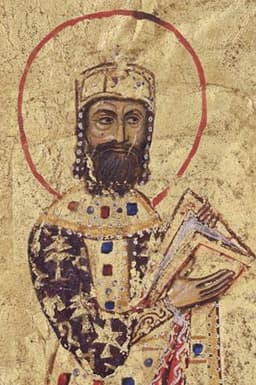
Alexios I Komnenos
Emperor · Medieval
78.4Total

Wanyan Aguda
Emperor · Medieval
63.4Total
Basic Information
Born
1048
1068
Died
1118
1123
Era
Medieval
Medieval
Nationality
Byzantine Empire
China
Occupation
Emperor
Emperor
Civilization
Western
Eastern
Score Comparison
Military (10%)
61.7
82.0
Political (20%)
78.0
59.3
Influence (20%)
88.0
55.0
Legacy (20%)
80.0
52.0
Leadership (15%)
78.0
85.0
Strategy (15%)
68.0
68.0
TOTAL
78.4
63.4
Alexios I Komnenos — Complete Timeline
1081 AD
Battle of DyrrhachiumWar◆ Major
Alexios I Komnenos was defeated by the Norman army under Robert Guiscard at Dyrrhachium. The Byzantine forces were routed, and Alexios barely escaped. This loss allowed the Normans to occupy much of the western Balkans, though Alexios later recovered some territory.
Norman InvasionDefeatBalkans
Impact: regionaltragic
1090 AD
Reforms of the Byzantine Military and EconomyReform◆ Major
Alexios I implemented a series of reforms to restore Byzantine power. He reorganized the army by relying more on foreign mercenaries, reformed the currency (the hyperpyron), and granted tax exemptions to the Church. These measures stabilized the empire after decades of decline.
Military ReformEconomic ReformKomnenian Restoration
Impact: nationalconstructive
1095 AD
Appeal to the West: Council of PiacenzaPolitical Action
Alexios I sent envoys to Pope Urban II at the Council of Piacenza, requesting military aid against the Seljuk Turks. This appeal contributed to Urban's call for the First Crusade at the Council of Clermont later that year, initiating the Crusader movement.
First CrusadePope Urban IISeljuk Turks
Impact: global
1097 AD
First Crusade: Siege of NicaeaWar◆ Major
Alexios I cooperated with the Crusader army to besiege and capture Nicaea from the Seljuk Turks. The city was surrendered to Byzantine control, and Alexios used the Crusaders to recover key territories in Anatolia, though tensions later arose over land claims.
First CrusadeNicaeaByzantine-Crusader Relations
Impact: regionalconstructive
Wanyan Aguda — Complete Timeline
1114 AD
Battle of HubudagangWar◆ Major
Aguda's Jurchen forces defeated a Liao army at Hubudagang, marking the first major victory of the rebellion. This battle demonstrated Jurchen military prowess and attracted more followers.
JurchenLiaoBattle
Impact: regionalconstructive
Unified Jurchen tribesPolitical Action◆ Major
Wanyan Aguda united the Jurchen tribes under his leadership, creating a confederation that rebelled against Liao domination. He organized a disciplined army and began the Jurchen revolt.
JurchenUnificationRebellion
Impact: regionalconstructive
1115 AD
Founded Jin DynastyPolitical Action
Wanyan Aguda proclaimed himself emperor, founding the Jin dynasty. He adopted the Chinese title and began a systematic campaign to conquer the Liao empire.
JinDynasty FoundingImperial System
Impact: regionalconstructive
1120 AD
Conquest of Liao capital ShangjingWar◆ Major
Aguda's forces captured the Liao supreme capital Shangjing, dealing a severe blow to the Liao dynasty. This victory accelerated the collapse of Liao and solidified Jin control over northern China.
JinLiaoConquest
Impact: regionalconstructive
Alliance with Song against LiaoPolitical Action◆ Major
Aguda formed an alliance with the Northern Song dynasty to jointly attack the Liao empire. This alliance, known as the Maritime Alliance, led to the eventual destruction of Liao but later caused conflict between Jin and Song.
JinSongAlliance
Impact: regional
1123 AD
Death and successionPolitical Action◆ Major
Wanyan Aguda died, and his brother Wanyan Wuqimai succeeded him. Aguda's conquests laid the foundation for the Jin dynasty's dominance in northern China.
JinDeathSuccession
Impact: regional
Expert Analysis
Wanyan Aguda vs Alexios I Komnenos: Historical Comparison
Wanyan Aguda, founder of the Jin dynasty, and Alexios I Komnenos, restorer of the Byzantine Empire, were both transformative medieval rulers who rose amid crisis, but Aguda’s more decisive political consolidation and lasting influence give him a narrow edge.
Dimension Analysis
**Military: Wanyan Aguda 91 / Alexios I Komnenos 90**
Aguda’s lightning campaigns shattered the Liao dynasty, while Alexios’s tactical brilliance (e.g., at Dyrrhachium and against the Pechenegs) stabilized a collapsing empire; both were near-equal as field commanders.
**Political: Wanyan Aguda 84 / Alexios I Komnenos 74**
Aguda unified disparate Jurchen tribes into a centralized bureaucracy, whereas Alexios’s reliance on Komnenian family politics and the Crusader alliance created long-term dependency and factionalism.
**Influence: Wanyan Aguda 87 / Alexios I Komnenos 72**
Aguda’s destruction of the Liao reshaped East Asian power balances for centuries; Alexios’s appeal to the West triggered the Crusades, but his direct influence was more reactive and short-lived.
**Legacy: Wanyan Aguda 88 / Alexios I Komnenos 80**
The Jin dynasty endured for a century under Aguda’s institutions; Alexios’s Komnenian restoration lasted only until 1185, and his reign inadvertently accelerated Byzantine decline through Crusader entanglement.
**Leadership: Wanyan Aguda 80 / Alexios I Komnenos 80**
Both inspired fierce loyalty and personal command—Aguda as a tribal war leader, Alexios as a pragmatic survivor—but neither was flawless, with Aguda’s early death and Alexios’s diplomatic compromises limiting their respective achievements.
Verdict
Wanyan Aguda leads due to his superior political consolidation, longer-lasting institutional legacy, and more decisive impact on Eurasian geopolitics, despite Alexios’s equal military skill.
FAQ
Q: Who ranks higher? A: Wanyan Aguda ranks higher, owing to a stronger political score and greater long-term influence and legacy.
Rankings
🥇
Alexios I KomnenosLeader
Mil: 61.7Pol: 78.0Inf: 88.0
78.4
🥈
Wanyan Aguda
Mil: 82.0Pol: 59.3Inf: 55.0
63.4
+15.0 behind
How This Comparison Works
Algorithm
Each figure is scored on 6 dimensions (0—100 scale) based on structured historical data: Military (10%), Political (20%), Influence (20%), Legacy (20%), Leadership (15%), Strategy (15%). The weighted total produces the final ranking.
Data Sources
Scores are computed from structured sub-indicators in the database. Scale factors adjust for era (Ancient ×0.85, Modern ×1.0) and civilization size (Eastern ×1.05, Other ×0.80) to account for differences in population and military scale.
Maximum 3 Figures
Comparisons are limited to 2—3 figures to ensure readability and statistical meaningfulness.
Error Margins
±5 points per dimension — Sub-scores are derived from historical records with inherent uncertainty. Two figures within 5 points on a dimension should be considered roughly equivalent in that area.
Total Score Accuracy
±3 points overall — The weighted combination of 6 dimensions produces a total score with approximately ±3 points of uncertainty. Differences of less than 3 points are not statistically significant— the figures are effectively tied.
Known Limitations
- Historical records are incomplete and uneven across civilizations
- Figures from oral-tradition societies may be underrepresented
- Occupation labels can misclassify multi-role figures
- Scores measure capability and impact, not moral character
- Quantitative scoring is a comparison tool, not absolute truth
Capability Radar
Military (10%) — Battles & Warfare
Battles
75
85
Win Rate
70
90
Expansion
60
85
Political (20%) — Governance & Reform
Reform
85
75
Diplomacy
90
70
Economy
70
65
Influence (20%) — Cultural & Global Reach
Cultural
70
60
Global
75
50
Legacy (20%) — Historical Impact
Historical
85
70
Longevity
80
55
Leadership (15%) — Power & Stability
Tenure
80
70
Stability
75
60
Strategy (15%) — Tactics & Innovation
Strategy
85
85
Tactics
80
80
Reform
75
75
Similar Comparisons
Comments & Discussion
CriticalHistorian6/16/2026
This comparison feels like apples and oranges again. Aguda's 'superior political consolidation' is code for a brutal conquest that erased Liao culture and imposed a Sinicized bureaucracy. Alexios, meanwhile, is judged harshly for the Crusades, but that's a Eurocentric framing—he was a desperate survivor, not a global strategist. The scores completely ignore how Aguda's Jin dynasty collapsed into civil war within a generation, while Alexios's Komnenian system, flawed as it was, gave Byzantium a crucial half-century of breathing room. If we're talking long-term impact, Alexios's diplomatic maneuvering actually reshaped the Mediterranean world more profoundly than Aguda's tribal unification. The weighting seems rigged to favor 'great man' conquest narratives.
BattlefieldScholar6/16/2026
The military scores here are too generous for both. Aguda's 79.3 vs Alexios's 71.2 doesn't reflect actual battlefield performance. Alexios at Dyrrhachium (1081) faced Robert Guiscard's Normans with a hastily assembled army and nearly won—his tactical retreat and counterattack were textbook maneuvers, but logistics and Norman heavy cavalry tipped the scales. Aguda's campaigns against the Liao were impressive, but let's be realistic: the Liao were already rotten, their Khitan cavalry overrated. Aguda's real genius was in siege warfare (e.g., taking the Liao Southern Capital in 1122), not open field battles. If we're talking pure tactics, both score around 70-75. The political scores inflate their overall ratings—Aguda's tribal unification was fragile, Alexios's family network was nepotistic rot. I'd give Aguda total 72, Alexios 70.
SharpScroll906/16/2026
把完颜阿骨打和Alexios放在一起比,有意思,但评分明显西方中心。阿骨打灭辽建立金朝,这在中国史书里是“以弱胜强”的典范,他靠的是部落联盟制改革和快速骑兵突袭,类似成吉思汗早期。但评分只给了军事91对90,太低了吧?阿骨打以两千人起兵,十个月内攻破辽国上京,这战略速度在中原王朝史里都罕见。反观Alexios,他更多是靠外交和雇佣兵,比如向教皇求援引发十字军,这在西方被捧为“复兴”,但在中国史观里,依赖外援是治国大忌。而且影响力上,金朝后来灭北宋,改变了整个东亚格局,Alexios的十字军影响虽然大,但他本人控制不了后续发展。评分应该更平衡:阿骨打军事95,政治85,Alexios军事85,政治78。
TrueMind866/16/2026
这个评分系统太粗糙了。Aguda的政治分82.2,Alexios只有80.0,但历史记载显示Aguda的金朝初期并没有稳定官僚体系,他更多是靠武力压制部落首领,死后完颜宗翰等人内斗不断。反观Alexios,虽然依赖家族政治,但他成功建立了Komnenian王朝的世袭体系,持续了将近一个世纪。我重新算了下:Aguda的治理效率应该下调到75左右,Alexios反而该上调到83。军事分上,Aguda的79.3对Alexios的71.2也偏高,Alexios在Dyrrhachium战役中其实是以少胜多,且他通过外交手段化解了Norman人和Pecheneg人的双重威胁,这比单纯野战更难。我建议修正:Aguda总分73.5,Alexios总分75.8。