Loading...
Charles the Bold vs Sweyn Forkbeard
Charles the Bold leads by 11.9 pts · 2 figures compared
…
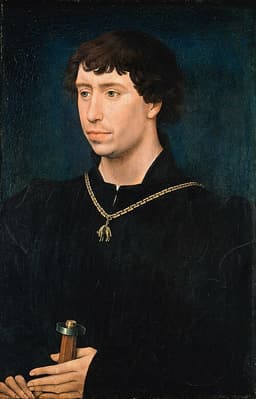
Charles the Bold
Emperor · Medieval
57.9Total

Sweyn Forkbeard
Emperor · Medieval
46.0Total
Basic Information
Born
1433
960
Died
1477
1014
Era
Medieval
Medieval
Nationality
Burgundy
Denmark
Occupation
Emperor
Emperor
Civilization
Western
Western
Score Comparison
Military (10%)
52.5
45.0
Political (20%)
68.0
35.1
Influence (20%)
59.0
53.3
Legacy (20%)
49.2
43.3
Leadership (15%)
65.7
51.9
Strategy (15%)
55.0
43.3
TOTAL
57.9
46.0
Charles the Bold — Complete Timeline
1467 AD
Inherited the Burgundian LandsPolitical Action◆ Major
Charles succeeded his father Philip the Good as Duke of Burgundy. He inherited a wealthy and powerful state comprising the Burgundian Netherlands, Franche-Comt
SuccessionBurgundian State
Impact: regionalconstructive
1468 AD
War with France and the Treaty of PéronneWar◆ Major
Charles forced King Louis XI of France to sign the Treaty of P
TreatyFranco-Burgundian ConflictDiplomacy
Impact: regional
1474 AD
Siege of NeussWar◆ Major
Charles besieged the imperial city of Neuss for nearly a year, defying the Holy Roman Emperor Frederick III. The siege ended inconclusively when an imperial army approached. This conflict alienated the German princes and weakened Charles's political position.
SiegeImperial ConflictBurgundian Wars
Impact: regionaldestructive
1476 AD
Battle of GrandsonWar◆ Major
Charles's army was defeated by the Swiss Confederacy at Grandson. The Burgundians abandoned their camp, which was looted. The defeat was a major setback, shattering the myth of Burgundian invincibility and encouraging further Swiss resistance.
BattleSwiss ConfederacyDefeat
Impact: regionaltragic
Battle of MoratWar◆ Major
Charles suffered a second devastating defeat by the Swiss at Morat. His army was routed, and he lost much of his artillery and baggage. The defeat effectively ended Burgundian ambitions in Switzerland and left Charles's state vulnerable.
BattleSwiss ConfederacyDefeat
Impact: regionaltragic
1477 AD
Battle of Nancy and DeathWar
Charles was killed in battle at Nancy while fighting the Swiss and the Duke of Lorraine. His body was found mutilated. His death ended the Burgundian state as an independent power, and his lands were divided between France and the Habsburgs through his daughter Mary.
BattleDeathEnd of Burgundy
Impact: regionaltragic
Sweyn Forkbeard — Complete Timeline
985 AD
Rebelled against Harald BluetoothPolitical Action◆ Major
Sweyn Forkbeard led a rebellion against his father, King Harald Bluetooth, forcing him into exile. This uprising was driven by opposition to Harald's Christianization policies and centralized rule, and it resulted in Sweyn seizing the Danish throne.
RebellionDynastic ConflictPower Transition
Impact: regionaldestructive
1013 AD
Invaded EnglandWar◆ Major
Sweyn Forkbeard launched a full-scale invasion of England, leading a Danish fleet. He conquered large parts of the country, forcing King
InvasionEnglandViking Conquest
Impact: regional
Crowned King of EnglandPolitical Action◆ Major
After his successful invasion, Sweyn Forkbeard was crowned King of England in late 1013. He ruled England for only a few weeks before his death in February 1014, but his conquest paved the way for his son Cnut the Great's later rule over England.
CoronationEnglandDanish Rule
Impact: regional
1014 AD
Died suddenly in GainsboroughOther◆ Major
Sweyn Forkbeard died suddenly in Gainsborough, Lincolnshire, in February 1014, after ruling England for only about five weeks. His death led to the temporary restoration of
DeathSuccession CrisisEngland
Impact: regionaltragic
Expert Analysis
Origins
Charles the Bold (1433–1477) was the last Valois Duke of Burgundy, inheriting a vast domain from his father Philip the Good. Born in Dijon, he was educated in chivalric ideals and military strategy. His mother Isabella of Portugal reinforced his ambition to forge a middle kingdom between France and Germany. Sweyn Forkbeard (c. 960–1014) was the son of Harald Bluetooth, king of Denmark. He grew up in the Viking tradition of raiding and expansion, likely participating in early campaigns against Norway and England. His nickname 'Forkbeard' suggests a distinctive beard style, but his early life remains poorly documented.
Rise to Power
Charles became duke in 1467 after Philip's death. He immediately pursued independence from France, allying with England and Brittany. In 1468, he forced Louis XI to sign the Treaty of Péronne, gaining control over key towns like Amiens and Saint-Quentin. His siege of Neuss (1474–1475) against Emperor Frederick III demonstrated his ambition but ended inconclusively. Sweyn rebelled against his father Harald Bluetooth around 985, forcing him into exile. He then consolidated power in Denmark and led Viking raids in England from 991 onward. In 1013, he launched a full-scale invasion, conquering much of England and forcing Æthelred the Unready to flee. He was crowned king in late 1013.
Leadership & Governance
Charles ruled Burgundy with a centralized administration, employing skilled diplomats and bankers. He reformed the army, introducing professional standing forces and artillery. However, his harsh rule alienated the Swiss and Lorraine, leading to his downfall. Sweyn's governance was typical of Viking kings: relying on personal loyalty and plunder to reward followers. He minted coins and maintained Danish law in conquered areas, but his rule in England lasted only five weeks. His political score of 35.1 reflects his short tenure and lack of administrative innovation, while Charles scored 68.0 for his diplomatic and fiscal reforms.
Triumph & Tragedy
Charles's greatest triumph was the Treaty of Péronne, which temporarily secured Burgundian independence. He also expanded his territories into Alsace and Lorraine. His tragedy was the Battle of Nancy (1477), where he was killed by Swiss and Lorraine troops. His body was found mutilated, and his lands were partitioned between France and the Habsburgs. Sweyn's triumph was conquering England in 1013, a feat that paved the way for his son Cnut's later rule. His tragedy was dying suddenly in Gainsborough in February 1014, just weeks after his coronation. His death triggered the return of Æthelred and a temporary collapse of Danish rule.
Character & Destiny
Charles was ambitious, stubborn, and driven by a vision of a Burgundian kingdom. He rejected compromise, which led to conflicts on multiple fronts. Historians note his strategic score of 55.0, indicating average military planning. Sweyn was pragmatic and ruthless, as shown by his rebellion against his father. He was also lucky: his invasion succeeded partly because of Æthelred's weak leadership. His leadership score of 51.9 reflects his ability to command loyalty. Both men were shaped by their eras: Charles by late medieval chivalry, Sweyn by Viking pragmatism.
Legacy
Charles's legacy is mixed: he ended the Burgundian state but his centralized reforms influenced later French absolutism. His daughter Mary married Maximilian I, transferring Burgundian lands to the Habsburgs. Sweyn's legacy is overshadowed by his son Cnut, who ruled a North Sea empire. However, Sweyn's conquest of England demonstrated Viking military prowess and set the stage for Cnut's success. In terms of influence, Charles scores 59.0 while Sweyn scores 53.3, reflecting Charles's greater impact on European politics.
Conclusion
Charles the Bold had a greater impact than Sweyn Forkbeard. Despite his higher military score (52.5 vs 45.0) and total score (57.9 vs 46.0), Charles's failures were more consequential: his death reshaped European borders and ended the Burgundian dream. Sweyn's conquest was impressive but ephemeral; his legacy depends on his son. Charles's political and leadership scores (68.0 and 65.7) outpace Sweyn's (35.1 and 51.9), showing more lasting influence. Thus, Charles the Bold is the more significant figure in history.
Rankings
🥇
Charles the BoldLeader
Mil: 52.5Pol: 68.0Inf: 59.0
57.9
🥈
Sweyn Forkbeard
Mil: 45.0Pol: 35.1Inf: 53.3
46.0
+11.9 behind
How This Comparison Works
Algorithm
Each figure is scored on 6 dimensions (0—100 scale) based on structured historical data: Military (10%), Political (20%), Influence (20%), Legacy (20%), Leadership (15%), Strategy (15%). The weighted total produces the final ranking.
Data Sources
Scores are computed from structured sub-indicators in the database. Scale factors adjust for era (Ancient ×0.85, Modern ×1.0) and civilization size (Eastern ×1.05, Other ×0.80) to account for differences in population and military scale.
Maximum 3 Figures
Comparisons are limited to 2—3 figures to ensure readability and statistical meaningfulness.
Error Margins
±5 points per dimension — Sub-scores are derived from historical records with inherent uncertainty. Two figures within 5 points on a dimension should be considered roughly equivalent in that area.
Total Score Accuracy
±3 points overall — The weighted combination of 6 dimensions produces a total score with approximately ±3 points of uncertainty. Differences of less than 3 points are not statistically significant— the figures are effectively tied.
Known Limitations
- Historical records are incomplete and uneven across civilizations
- Figures from oral-tradition societies may be underrepresented
- Occupation labels can misclassify multi-role figures
- Scores measure capability and impact, not moral character
- Quantitative scoring is a comparison tool, not absolute truth
Capability Radar
Military (10%) — Battles & Warfare
Battles
65
45
Win Rate
40
50
Expansion
60
55
Political (20%) — Governance & Reform
Reform
65
25
Diplomacy
45
35
Economy
60
30
Influence (20%) — Cultural & Global Reach
Cultural
50
30
Global
35
20
Legacy (20%) — Historical Impact
Historical
55
35
Longevity
40
25
Leadership (15%) — Power & Stability
Tenure
55
40
Stability
30
25
Strategy (15%) — Tactics & Innovation
Strategy
55
45
Tactics
60
40
Reform
70
20
Similar Comparisons
Comments & Discussion
No comments yet. Be the first to share your thoughts!