Loading...
Du Yu vs Yuwen Tai
Yuwen Tai leads by 4.7 pts · 2 figures compared
…
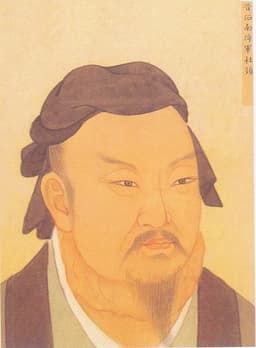
Du Yu
General · Ancient
56.8Total

Yuwen Tai
General · Ancient
61.5Total
Basic Information
Born
222
-507
Died
285
—
Era
Ancient
Ancient
Nationality
China
China
Occupation
General
General
Civilization
Eastern
Eastern
Score Comparison
Military (10%)
77.5
85.0
Political (20%)
43.7
62.7
Influence (20%)
53.3
61.0
Legacy (20%)
47.5
52.0
Leadership (15%)
65.0
48.8
Strategy (15%)
75.0
80.0
TOTAL
56.8
61.5
Du Yu — Complete Timeline
279 AD
Appointed as commander of the Jin invasion of WuPolitical Action◆ Major
Du Yu was appointed as the overall commander of the Jin forces for the invasion of Eastern Wu, following Yang Hu's recommendation. He was given command of the central army group.
Jin DynastyEastern WuMilitary Command
Impact: nationalconstructive
280 AD
Led the conquest of Eastern WuWar
Du Yu's forces captured key Wu cities, including Jiangling, and advanced toward the Wu capital Jianye. The campaign culminated in the surrender of Wu's emperor Sun Hao, ending the Three Kingdoms period.
Conquest of WuJin DynastyUnification
Impact: globalconstructive
Authored the 'Commentary on the Spring and Autumn Annals'Cultural◆ Major
Du Yu wrote a comprehensive commentary on the Confucian classic 'Spring and Autumn Annals', which became a standard reference for later scholars. His work influenced Chinese historiography.
ScholarshipConfucianismHistoriography
Impact: nationalconstructive
Yuwen Tai — Complete Timeline
535 AD
Founded the Western Wei dynastyPolitical Action◆ Major
Yuwen Tai established the Western Wei dynasty after the split of the Northern Wei. He served as regent and de facto ruler, with the Yuan clan as figurehead emperors, and implemented military and administrative reforms.
Dynasty FoundingReformNorthern China
Impact: regionalconstructive
537 AD
Defeated the Eastern Wei at the Battle of ShaxianWar◆ Major
Yuwen Tai led Western Wei forces to victory against the larger Eastern Wei army at Shaxian. This battle secured the survival of Western Wei and established Yuwen Tai's military reputation.
BattleVictoryEastern Wei
Impact: regionalconstructive
540 AD
Implemented the Fubing systemReform◆ Major
Yuwen Tai introduced the Fubing militia system, which organized farmer-soldiers into garrisons. This system provided a stable military force and became the basis for the Sui and Tang military systems.
Military ReformFubingInstitution
Impact: regionalconstructive
556 AD
Death and succession by Yuwen HuOther◆ Major
Yuwen Tai died of illness. His nephew Yuwen Hu took over as regent, later forcing the abdication of the Western Wei emperor and founding the Northern Zhou dynasty, fulfilling Yuwen Tai's legacy.
DeathSuccessionNorthern Zhou
Impact: regional
Expert Analysis
Origins
Du Yu (222-285) was born into a prominent scholar-official family in the state of Cao Wei during the Three Kingdoms period. His grandfather Du Ji served as a governor, and his father Du Shu was a notable official. Du Yu received a classical education and showed early aptitude for military strategy, but his career began in civil administration. He was known for his love of learning, particularly the Confucian classic 'Spring and Autumn Annals', which he would later annotate.
Yuwen Tai (507-556) was born into the Xianbei Yuwen clan, part of the military elite of the Northern Wei dynasty. His father, Yuwen Gong, was a general, and Yuwen Tai grew up in a martial environment. He joined the army in his youth and quickly rose through the ranks due to his military skills and leadership. Unlike Du Yu, Yuwen Tai's background was purely military, with little formal education.
Rise to Power
Du Yu rose to prominence during the Jin dynasty under Sima Yan (Emperor Wu). He served as a regional governor and military commander, gaining experience in logistics and strategy. His key turning point came when he was recommended by Yang Hu, the previous commander of the Jin invasion of Eastern Wu, to lead the campaign. In 279, Du Yu was appointed overall commander of the Jin forces for the conquest of Wu. He coordinated a multi-pronged attack, capturing key cities like Jiangling and advancing toward the Wu capital Jianye. The campaign succeeded in 280, unifying China under Jin rule.
Yuwen Tai's rise began during the chaos of the Northern Wei's collapse. He served under the warlord Helianbada and later under Gao Huan, but after a falling out, he fled to the Guanzhong region. In 534, when the Northern Wei split, Yuwen Tai supported the Yuan clan as figurehead emperors and established the Western Wei dynasty. He became regent and de facto ruler, consolidating power through military reforms and alliances. His victory at the Battle of Shaxian in 537 against the larger Eastern Wei army secured Western Wei's survival and cemented his authority.
Leadership & Governance
Du Yu's leadership style was methodical and strategic. He emphasized careful planning and logistics, ensuring his army was well-supplied and his campaigns meticulously prepared. As a governor, he implemented agricultural reforms to boost production and stability. However, his political influence was limited (political score 43.7), as he focused more on military and scholarly pursuits. He is known for his commentary on the Spring and Autumn Annals, which integrated his strategic thinking with Confucian principles.
Yuwen Tai was a transformative leader with a political score of 62.7. He implemented the Fubing system, a militia system that organized farmer-soldiers into garrisons, providing a stable military force and reducing costs. He also reformed the bureaucracy, adopting elements of Zhou dynasty rituals to legitimize his rule. His governance focused on centralization and military efficiency, laying the foundation for the Northern Zhou and later Sui dynasties. Yuwen Tai's leadership score of 48.8 reflects his authoritarian tendencies and reliance on clan loyalty.
Triumph & Tragedy
Du Yu's greatest triumph was the conquest of Eastern Wu in 280, ending the Three Kingdoms period. His strategic planning and coordination led to a swift victory with minimal prolonged conflict. He also made a lasting scholarly contribution with his 'Commentary on the Spring and Autumn Annals', which became a standard reference. However, his failures include limited political influence after the conquest—he was not able to shape the subsequent governance of the unified empire. He died in 285, relatively soon after the campaign, and his reforms did not endure.
Yuwen Tai's triumphs include founding the Western Wei dynasty and defeating Eastern Wei at Shaxian, ensuring his state's survival. The Fubing system he introduced persisted through the Sui and Tang dynasties, influencing Chinese military organization for centuries. His tragedy was his early death at age 49, which left his regime in the hands of his nephew Yuwen Hu, who later usurped the throne. Yuwen Tai's political ambitions were cut short, and his dynasty was short-lived, replaced by the Northern Zhou.
Character & Destiny
Du Yu was known for his intellectual humility and strategic foresight. He was a scholar-general who combined book learning with practical military command. His character shaped his destiny: his careful planning led to success, but his lack of political ambition limited his post-war influence. He scored 65.0 in leadership, reflecting his ability to command respect but not to dominate politically.
Yuwen Tai was pragmatic and ruthless, willing to use Xianbei tribal structures to build a state. His character was shaped by the chaotic era; he seized opportunities and made bold decisions. His high military (85.0) and strategy (80.0) scores reflect his battlefield prowess and institutional reforms. However, his reliance on clan loyalty and failure to secure a stable succession led to instability after his death.
Legacy
Du Yu's legacy is twofold: military and scholarly. His conquest of Wu is remembered as a key event in Chinese unification. His commentary on the Spring and Autumn Annals influenced Confucian scholarship for centuries. However, his military innovations were not lasting, and his personal political impact was limited (legacy score 47.5). He is primarily known as a capable general and scholar.
Yuwen Tai's legacy is more profound. The Fubing system became a model for later dynasties, and his state-building efforts laid the groundwork for the reunification of China under the Sui and Tang. His political and military structures influenced Chinese governance for centuries. Despite his early death, his legacy score of 52.0 reflects his enduring impact on Chinese history.
Conclusion
Yuwen Tai had a greater overall impact on Chinese history than Du Yu. His total score of 61.5 exceeds Du Yu's 56.8 by 4.7 points. While Du Yu's conquest of Wu was significant, it was a single campaign that completed a process already underway. In contrast, Yuwen Tai founded a dynasty, introduced a lasting military system, and shaped the political landscape that led to the Sui and Tang golden age. His higher scores in military (85.0 vs 77.5), political (62.7 vs 43.7), and influence (61.0 vs 53.3) reflect his broader contributions. Du Yu's scholarly work is notable, but Yuwen Tai's institutional reforms had a more enduring effect on Chinese civilization.
Rankings
🥇
Yuwen TaiLeader
Mil: 85.0Pol: 62.7Inf: 61.0
61.5
🥈
Du Yu
Mil: 77.5Pol: 43.7Inf: 53.3
56.8
+4.7 behind
How This Comparison Works
Algorithm
Each figure is scored on 6 dimensions (0—100 scale) based on structured historical data: Military (10%), Political (20%), Influence (20%), Legacy (20%), Leadership (15%), Strategy (15%). The weighted total produces the final ranking.
Data Sources
Scores are computed from structured sub-indicators in the database. Scale factors adjust for era (Ancient ×0.85, Modern ×1.0) and civilization size (Eastern ×1.05, Other ×0.80) to account for differences in population and military scale.
Maximum 3 Figures
Comparisons are limited to 2—3 figures to ensure readability and statistical meaningfulness.
Error Margins
±5 points per dimension — Sub-scores are derived from historical records with inherent uncertainty. Two figures within 5 points on a dimension should be considered roughly equivalent in that area.
Total Score Accuracy
±3 points overall — The weighted combination of 6 dimensions produces a total score with approximately ±3 points of uncertainty. Differences of less than 3 points are not statistically significant— the figures are effectively tied.
Known Limitations
- Historical records are incomplete and uneven across civilizations
- Figures from oral-tradition societies may be underrepresented
- Occupation labels can misclassify multi-role figures
- Scores measure capability and impact, not moral character
- Quantitative scoring is a comparison tool, not absolute truth
Capability Radar
Military (10%) — Battles & Warfare
Battles
70
65
Win Rate
85
70
Expansion
75
70
Political (20%) — Governance & Reform
Reform
55
85
Diplomacy
60
70
Economy
50
75
Influence (20%) — Cultural & Global Reach
Cultural
40
60
Global
30
55
Legacy (20%) — Historical Impact
Historical
55
75
Longevity
40
70
Leadership (15%) — Power & Stability
Tenure
65
75
Stability
55
70
Strategy (15%) — Tactics & Innovation
Strategy
80
80
Tactics
75
75
Reform
60
85
Similar Comparisons
Comments & Discussion
No comments yet. Be the first to share your thoughts!