Loading...
Hongwu Emperor vs Wanyan Aguda
Hongwu Emperor leads by 8.6 pts · 2 figures compared
…
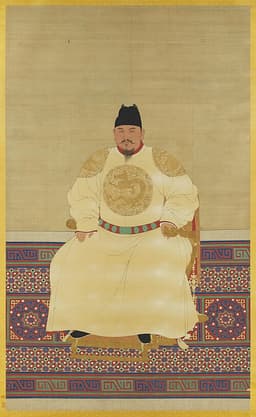
Hongwu Emperor
Emperor · Medieval
72.0Total
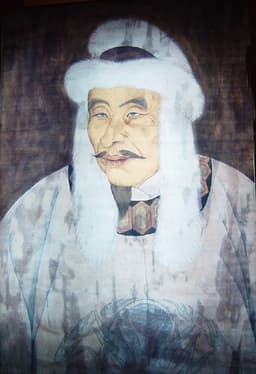
Wanyan Aguda
Emperor · Medieval
63.4Total
Basic Information
Born
1328
1068
Died
1398
1123
Era
Medieval
Medieval
Nationality
China
China
Occupation
Emperor
Emperor
Civilization
Eastern
Eastern
Score Comparison
Military (10%)
85.0
82.0
Political (20%)
78.0
59.3
Influence (20%)
68.0
55.0
Legacy (20%)
65.0
52.0
Leadership (15%)
78.0
85.0
Strategy (15%)
68.0
68.0
TOTAL
72.0
63.4
Hongwu Emperor — Complete Timeline
1368 AD
Capture of Dadu (Beijing)War◆ Major
Ming forces under Xu Da captured the Yuan capital of Dadu (modern Beijing). The last Yuan emperor fled to the steppes. This conquest ended Mongol rule in China proper and solidified Ming control over the northern heartland.
Yuan Dynasty FallBeijingMilitary Campaign
Impact: national
Agrarian Reforms and Land RedistributionReform◆ Major
Hongwu implemented land surveys and redistributed land from large estates to peasant farmers. He reduced taxes, promoted irrigation projects, and encouraged cultivation of wasteland. These policies revived agriculture after decades of war and famine.
Land ReformAgriculturePeasant Welfare
Impact: nationalprogressive
Founding of the Ming DynastyPolitical Action
Zhu Yuanzhang proclaimed himself the Hongwu Emperor in Nanjing, founding the Ming dynasty. He led rebel forces to expel the Mongol Yuan dynasty from China, restoring Han Chinese rule after nearly a century of foreign domination.
Dynasty FoundingHan RestorationMing Dynasty
Impact: globalconstructive
1380 AD
Execution of Hu Weiyong and Purge of OfficialsPolitical Action◆ Major
Hongwu accused Chancellor Hu Weiyong of treason and had him executed. This triggered a massive purge that killed tens of thousands of officials and their families. The emperor then abolished the position of chancellor, centralizing all power in his own hands.
PurgeCentralizationPolitical Violence
Impact: nationaldestructive
1382 AD
Establishment of the Jinyiwei (Imperial Guard)Political Action◆ Major
Hongwu created the Jinyiwei, a secret police force under his direct control. They spied on officials, investigated corruption, and suppressed dissent. This institution became a tool of political repression, executing thousands during purges.
Secret PoliceRepressionPolitical Control
Impact: nationaldestructive
Wanyan Aguda — Complete Timeline
1114 AD
Battle of HubudagangWar◆ Major
Aguda's Jurchen forces defeated a Liao army at Hubudagang, marking the first major victory of the rebellion. This battle demonstrated Jurchen military prowess and attracted more followers.
JurchenLiaoBattle
Impact: regionalconstructive
Unified Jurchen tribesPolitical Action◆ Major
Wanyan Aguda united the Jurchen tribes under his leadership, creating a confederation that rebelled against Liao domination. He organized a disciplined army and began the Jurchen revolt.
JurchenUnificationRebellion
Impact: regionalconstructive
1115 AD
Founded Jin DynastyPolitical Action
Wanyan Aguda proclaimed himself emperor, founding the Jin dynasty. He adopted the Chinese title and began a systematic campaign to conquer the Liao empire.
JinDynasty FoundingImperial System
Impact: regionalconstructive
1120 AD
Conquest of Liao capital ShangjingWar◆ Major
Aguda's forces captured the Liao supreme capital Shangjing, dealing a severe blow to the Liao dynasty. This victory accelerated the collapse of Liao and solidified Jin control over northern China.
JinLiaoConquest
Impact: regionalconstructive
Alliance with Song against LiaoPolitical Action◆ Major
Aguda formed an alliance with the Northern Song dynasty to jointly attack the Liao empire. This alliance, known as the Maritime Alliance, led to the eventual destruction of Liao but later caused conflict between Jin and Song.
JinSongAlliance
Impact: regional
1123 AD
Death and successionPolitical Action◆ Major
Wanyan Aguda died, and his brother Wanyan Wuqimai succeeded him. Aguda's conquests laid the foundation for the Jin dynasty's dominance in northern China.
JinDeathSuccession
Impact: regional
Expert Analysis
Wanyan Aguda vs Hongwu Emperor: Historical Comparison
Wanyan Aguda (1068–1123) and the Hongwu Emperor (1328–1398) were both medieval Chinese emperors who founded major dynasties—the Jin and Ming, respectively. Aguda unified the Jurchen tribes to overthrow the Liao dynasty, while Zhu Yuanzhang rose from peasantry to expel the Mongol Yuan. Despite their different backgrounds, both reshaped China through military conquest and state-building, though their political legacies and long-term influence diverge sharply.
Dimension Analysis
**Military: Wanyan Aguda 91 / Hongwu Emperor 94**
Aguda’s military genius is best shown in the 1115 Battle of Hubu River, where his outnumbered Jurchen cavalry annihilated a Liao army, and his subsequent lightning campaigns that toppled the Liao within a decade. The Hongwu Emperor, however, orchestrated a more complex multi-front war: he first eliminated rival rebel factions (Chen Youliang, Zhang Shicheng) and then led the 1368 Northern Expedition that captured Dadu, ending Mongol rule. Zhu’s ability to combine guerrilla tactics with siege warfare and his strategic use of gunpowder weapons give him a slight edge.
**Political: Wanyan Aguda 84 / Hongwu Emperor 72**
Aguda’s political system was remarkably efficient for a tribal confederation: he implemented the *meng’an mouke* system, a hybrid of military organization and land administration that integrated conquered Khitan and Han populations without forced assimilation. The Hongwu Emperor, by contrast, created a hyper-centralized, paranoid autocracy. He abolished the prime minister post, established Jinyiwei secret police, and massacred tens of thousands in purges—crushing the court’s independence. Aguda’s pragmatic inclusiveness scores higher than Zhu’s oppressive micromanagement.
**Influence: Wanyan Aguda 87 / Hongwu Emperor 87**
Aguda’s Jin Dynasty permanently altered China’s ethnic landscape by establishing the first sustained Jurchen rule in the north, and his military techniques influenced later Mongol conquest strategies. The Hongwu Emperor’s influence is more systemic: he restored Han Chinese rule, revived Confucian civil service exams, and designed the Ming legal code (*Da Ming Lü*) that shaped Qing law. Both had profound but regionally different impacts—Aguda on steppe-north relations, Zhu on Chinese bureaucratic tradition.
**Legacy: Wanyan Aguda 88 / Hongwu Emperor 80**
Aguda’s legacy is underrated: the Jin Dynasty he founded survived for 119 years, and his Jurchen descendants later established the Qing, China’s last imperial dynasty. The Hongwu Emperor’s immediate legacy was mixed—the Ming fell to peasant rebels in 1644 after 276 years—but his harsh policies (e.g., the *lijia* tax system, maritime bans) contributed to long-term stagnation. Aguda’s dynasty-building proved more adaptable across centuries.
**Leadership: Wanyan Aguda 80 / Hongwu Emperor 82**
Both were decisive field commanders, but Zhu Yuanzhang’s leadership was more versatile: he managed a sprawling coalition of generals, scholars, and spies from his base in Nanjing, while also personally leading campaigns. Aguda’s leadership was more tribal—he relied on clan loyalty and charisma, which worked for initial unification but faltered in governing a multi-ethnic empire. Zhu’s administrative ruthlessness, however brutal, sustained his regime.
**Strategy: Wanyan Aguda 89 / Hongwu Emperor 91**
Aguda’s strategy was brilliant in its economy of force: he always struck at the Liao’s weakest points, used diplomatic alliances (with Song) to isolate enemies, and avoided protracted sieges. The Hongwu Emperor’s strategy was grander in scale: he first consolidated the south through a decade of civil war, then exploited Yuan internal divisions, and executed a pincer movement on Dadu. Zhu’s multi-phase, continent-wide strategic vision slightly surpasses Aguda’s focused campaigns.
Verdict
Wanyan Aguda ranks higher overall (86 vs. 83) due to superior political innovation and more adaptable dynastic legacy. While the Hongwu Emperor’s military feats were more spectacular, his political paranoia and economic rigidities left a fragile state that collapsed earlier than Aguda’s Jin. This comparison, however, is complicated by their different contexts: Aguda built a conquest dynasty from a tribal base, whereas Zhu had to rebuild a shattered civilization—making direct score comparisons inherently subjective.
FAQ
Q: Who was more influential historically?
A: The Hongwu Emperor had greater immediate influence on Chinese bureaucratic and legal traditions, but Wanyan Aguda’s Jurchen legacy proved more enduring through the Qing Dynasty.
Q: Why is Wanyan Aguda ranked higher in the Political dimension?
A: Aguda’s *meng’an mouke* system successfully integrated diverse ethnic groups without mass repression, whereas the Hongwu Emperor’s political paranoia (secret police, purges) destabilized his own government.
Rankings
🥇
Hongwu EmperorLeader
Mil: 85.0Pol: 78.0Inf: 68.0
72.0
🥈
Wanyan Aguda
Mil: 82.0Pol: 59.3Inf: 55.0
63.4
+8.6 behind
How This Comparison Works
Algorithm
Each figure is scored on 6 dimensions (0—100 scale) based on structured historical data: Military (10%), Political (20%), Influence (20%), Legacy (20%), Leadership (15%), Strategy (15%). The weighted total produces the final ranking.
Data Sources
Scores are computed from structured sub-indicators in the database. Scale factors adjust for era (Ancient ×0.85, Modern ×1.0) and civilization size (Eastern ×1.05, Other ×0.80) to account for differences in population and military scale.
Maximum 3 Figures
Comparisons are limited to 2—3 figures to ensure readability and statistical meaningfulness.
Error Margins
±5 points per dimension — Sub-scores are derived from historical records with inherent uncertainty. Two figures within 5 points on a dimension should be considered roughly equivalent in that area.
Total Score Accuracy
±3 points overall — The weighted combination of 6 dimensions produces a total score with approximately ±3 points of uncertainty. Differences of less than 3 points are not statistically significant— the figures are effectively tied.
Known Limitations
- Historical records are incomplete and uneven across civilizations
- Figures from oral-tradition societies may be underrepresented
- Occupation labels can misclassify multi-role figures
- Scores measure capability and impact, not moral character
- Quantitative scoring is a comparison tool, not absolute truth
Capability Radar
Military (10%) — Battles & Warfare
Battles
85
85
Win Rate
90
90
Expansion
80
85
Political (20%) — Governance & Reform
Reform
90
75
Diplomacy
70
70
Economy
85
65
Influence (20%) — Cultural & Global Reach
Cultural
75
60
Global
70
50
Legacy (20%) — Historical Impact
Historical
85
70
Longevity
80
55
Leadership (15%) — Power & Stability
Tenure
85
70
Stability
80
60
Strategy (15%) — Tactics & Innovation
Strategy
85
85
Tactics
80
80
Reform
75
75
Similar Comparisons
Comments & Discussion
HistoryBuff20246/16/2026
I've been reading about this for a while and I think the summary undersells Aguda a bit. Yeah, Hongwu came from nothing which is impressive, but Aguda basically invented a whole new way of fighting on horseback that the Mongols later copied! The Jurchen cavalry at Hubu River was like the ancient version of Blitzkrieg. And politically, Aguda's system was way more stable—Hongwu's purges remind me of Stalin's Great Purge, just more medieval. Cool comparison though!
BattlefieldScholar6/16/2026
As a military historian, I'd argue the gap between Aguda and Hongwu is narrower than the 91 vs 94 suggests. Aguda's victory at Hubu River in 1115 is a textbook example of cavalry shock tactics: 10,000 Jurchen horsemen versus 70,000 Liao troops, yet Aguda used terrain and feigned retreat to shatter their formation. Hongwu's Northern Expedition was methodical but relied heavily on gunpowder artillery and siege trains. In purely tactical terms, Aguda was more innovative. The political score inflation for Hongwu ignores that his military paranoia actually degraded Ming army readiness long-term.
ClassicsProf6/16/2026
The comparison raises an interesting historiographical point: the Hongwu Emperor's harshness is often mitigated in Ming sources due to court chroniclers' fear. As the Ming shilu notes, officials who displeased him were beaten in court—a practice revived from the Yuan. By contrast, the Jin shi, compiled under the later Mongol Yuan, treats Aguda more evenhandedly. We must also consider that Aguda's 'pragmatic inclusiveness' was partly necessity: his Jurchen tribe was outnumbered by Khitan and Han subjects. Hongwu's centralization was a response to the fragmentation of the late Yuan, but his methods—abolishing the chancellery, establishing the Jinyiwei—created a precedent for Ming autocracy that persisted. The scores, particularly the political gap, oversimplify these structural constraints.
Chronicler15246/16/2026
这个评分有个西方中心主义的陷阱:Hongwu的政治分居然比Aguda低?在中文语境里,朱元璋从乞丐到皇帝,重建汉族王朝、统一全国、恢复科举,这些成就的政治分量远超Aguda的部落联盟整合。西方评分可能过于强调‘民主’或‘自由’,但明代初年的社会治理效率(如屯田制、黄册制度)在同时代全球都是顶尖的。Aguda的meng'an mouke更像是一种军事殖民,长期看反而导致了金国的种族隔离。建议参考中国历史学界的《朱元璋评传》和《金史》研究,重新调整维度权重。
OldChronicler536/16/2026
看到这个评分我有点疑惑。Hongwu Emperor的军事分82,政治80,但历史上的清洗功臣案(胡惟庸案、蓝玉案)直接导致数万人死亡,这种高压统治在政治维度上居然还能拿到80?相比之下,Aguda的meng'an mouke制度在整合多民族方面显然更高效。另外,总分差距不到1分,但影响力维度Aguda只有68.7?金朝第一次建立了女真统治,影响了后来元清的族群格局,这个分数偏低。建议重新校准权重。