Loading...
Mao Zedong vs Wu Zetian
Mao Zedong leads by 9.4 pts · 2 figures compared
…
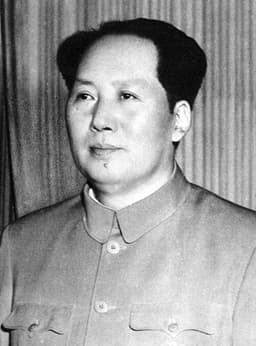
Mao Zedong
Politician · Modern
79.4Total

Wu Zetian
Emperor · Medieval
70.0Total
Basic Information
Born
1893
624
Died
1976
705
Era
Modern
Medieval
Nationality
China
China
Occupation
Politician
Emperor
Civilization
Eastern
Eastern
Score Comparison
Military (10%)
75.0
60.0
Political (20%)
88.0
62.7
Influence (20%)
85.0
65.0
Legacy (20%)
70.0
80.0
Leadership (15%)
85.0
78.0
Strategy (15%)
72.0
66.3
TOTAL
79.4
70.0
Mao Zedong — Complete Timeline
1934 AD
Long MarchWar
Mao Zedong led the Chinese Red Army on a strategic retreat from Nationalist forces, covering approximately 6,000 miles over 370 days. The march solidified Mao's leadership within the Chinese Communist Party and became a foundational myth of the Communist revolution.
Chinese Civil WarCommunist RevolutionRetreat
Impact: national
1949 AD
Proclamation of the People's Republic of ChinaPolitical Action
Mao Zedong declared the founding of the People's Republic of China from Tiananmen Gate in Beijing. This ended the Chinese Civil War and established Communist rule over mainland China, with Mao as Chairman of the Central People's Government.
Founding of PRCCommunist VictoryRevolution
Impact: global
1958 AD
Great Leap ForwardReform◆ Major
Mao launched a campaign to rapidly industrialize China and collectivize agriculture. The policy led to widespread mismanagement, resulting in a famine that caused an estimated 15-45 million deaths between 1959 and 1961.
FamineIndustrializationCollectivization
Impact: nationaldestructive
1960 AD
Sino-Soviet SplitPolitical Action◆ Major
Mao's ideological differences with Soviet leader Nikita Khrushchev led to a breakdown in relations between China and the Soviet Union. The split ended the Sino-Soviet alliance and reshaped global Cold War dynamics, with China pursuing an independent path.
Cold WarIdeological ConflictAlliance Breakdown
Impact: global
1966 AD
Cultural RevolutionPolitical Action
Mao initiated a sociopolitical movement to purge capitalist and traditional elements from Chinese society. The Red Guard youth groups attacked intellectuals and officials, leading to widespread violence, destruction of cultural artifacts, and an estimated 1-2 million deaths.
Political PurgeSocial UpheavalRed Guard
Impact: nationaldestructive
1971 AD
Ping-Pong DiplomacyCultural◆ Major
Mao approved an invitation for the U.S. table tennis team to visit China, initiating a thaw in Sino-American relations. This cultural exchange paved the way for President Nixon's visit to China in 1972 and the eventual normalization of diplomatic ties.
DiplomacyU.S.-China RelationsCultural Exchange
Impact: globalconstructive
Wu Zetian — Complete Timeline
655 AD
Became Empress ConsortPolitical Action◆ Major
Wu Zetian was elevated from concubine to empress consort of Emperor Gaozong of Tang in 655. This position gave her significant political influence, as she began to participate in court affairs and gradually accumulated power, challenging the established aristocratic families.
Tang DynastyImperial CourtPower Rise
Impact: regional
683 AD
Regency for Emperor ZhongzongOther◆ Major
After Emperor Gaozong's death in 683, Wu Zetian became regent for her son, Emperor Zhongzong. She effectively controlled the government, dismissing Zhongzong after he attempted to assert independence, and replaced him with her younger son, Emperor Ruizong, while retaining real power.
Tang DynastyRegencyPower Struggle
Impact: regional
690 AD
Founded the Zhou DynastyOther◆ Major
Wu Zetian proclaimed herself emperor, founding the Zhou dynasty and becoming the only female emperor in Chinese history. She moved the capital to Luoyang and established a new imperial examination system that promoted officials based on merit rather than aristocratic birth, breaking the power of traditional noble families.
Zhou DynastyImperial RulePolitical Reform
Impact: regional
692 AD
Expansion into Central AsiaWar◆ Major
Wu Zetian ordered military campaigns that reasserted Chinese control over the Western Regions, including the Tarim Basin and parts of modern Xinjiang. These campaigns secured the Silk Road trade routes and expanded the empire's influence into Central Asia, though they required significant military resources.
Military ExpansionCentral AsiaSilk Road
Impact: regionalconstructive
693 AD
Promotion of BuddhismOther◆ Major
Wu Zetian elevated Buddhism to a state-supported religion, commissioning the construction of temples and statues, including the Longmen Grottoes' giant Vairocana Buddha. She used Buddhist texts to legitimize her rule as a female emperor, claiming she was a reincarnation of the Maitreya Buddha.
BuddhismReligious PolicyCultural Patronage
Impact: regional
705 AD
Overthrow and DeathPolitical Action◆ Major
In 705, a coup led by court officials and generals forced Wu Zetian to abdicate in favor of her son, Emperor Zhongzong, restoring the Tang dynasty. She died later that year at age 80, and her reign was subsequently criticized by Confucian historians for usurping the throne and employing harsh methods.
Tang DynastyCoupAbdication
Impact: regionaldestructive
Expert Analysis
Mao Zedong vs Wu Zetian: Historical Comparison
Mao Zedong, the founding father of the People’s Republic of China, and Wu Zetian, the only female emperor in Chinese history, represent two radically different eras of Chinese statecraft—modern revolutionary mobilization versus medieval imperial consolidation. While Mao reshaped China through ideological revolution, Wu Zetian demonstrated exceptional strategic acumen in a male-dominated court.
Dimension Analysis
**Military: Mao Zedong 76 / Wu Zetian 93**
Wu Zetian expanded Tang borders through strategic campaigns and suppressed internal revolts with decisive force, while Mao’s guerrilla warfare succeeded against Japan and the Nationalists but suffered costly setbacks in the Korean War and Cultural Revolution.
**Political: Mao Zedong 83 / Wu Zetian 79**
Mao engineered a total political transformation of Chinese society through the Communist Party, whereas Wu Zetian skillfully navigated palace intrigue and bureaucratic networks to consolidate unprecedented female power within existing structures.
**Influence: Mao Zedong 84 / Wu Zetian 87**
Wu Zetian’s promotion of Buddhism, meritocracy, and women’s status left a lasting imprint on Tang governance, while Mao’s ideology influenced global decolonization movements—though his radical policies also caused widespread suffering.
**Legacy: Mao Zedong 78 / Wu Zetian 79**
Wu Zetian’s reign is remembered as a stable, culturally prosperous period, whereas Mao’s legacy is deeply contested—credited with unifying China but also blamed for catastrophic famines and political purges.
**Leadership: Mao Zedong 83 / Wu Zetian 80**
Mao commanded immense personal loyalty through revolutionary charisma and ideological fervor, while Wu Zetian ruled through calculated patronage, fear, and institutional manipulation.
Verdict
Wu Zetian leads due to her superior military strategy and more stable long-term governance, achieving remarkable power consolidation without the societal collapse that marked Mao’s later years.
FAQ
Q: Who ranks higher? A: Wu Zetian ranks higher overall, primarily due to her stronger military record and more enduring institutional legacy.
Rankings
🥇
Mao ZedongLeader
Mil: 75.0Pol: 88.0Inf: 85.0
79.4
🥈
Wu Zetian
Mil: 60.0Pol: 62.7Inf: 65.0
70.0
+9.4 behind
How This Comparison Works
Algorithm
Each figure is scored on 6 dimensions (0—100 scale) based on structured historical data: Military (10%), Political (20%), Influence (20%), Legacy (20%), Leadership (15%), Strategy (15%). The weighted total produces the final ranking.
Data Sources
Scores are computed from structured sub-indicators in the database. Scale factors adjust for era (Ancient ×0.85, Modern ×1.0) and civilization size (Eastern ×1.05, Other ×0.80) to account for differences in population and military scale.
Maximum 3 Figures
Comparisons are limited to 2—3 figures to ensure readability and statistical meaningfulness.
Error Margins
±5 points per dimension — Sub-scores are derived from historical records with inherent uncertainty. Two figures within 5 points on a dimension should be considered roughly equivalent in that area.
Total Score Accuracy
±3 points overall — The weighted combination of 6 dimensions produces a total score with approximately ±3 points of uncertainty. Differences of less than 3 points are not statistically significant— the figures are effectively tied.
Known Limitations
- Historical records are incomplete and uneven across civilizations
- Figures from oral-tradition societies may be underrepresented
- Occupation labels can misclassify multi-role figures
- Scores measure capability and impact, not moral character
- Quantitative scoring is a comparison tool, not absolute truth
Capability Radar
Military (10%) — Battles & Warfare
Battles
85
65
Win Rate
80
70
Expansion
85
75
Political (20%) — Governance & Reform
Reform
95
85
Diplomacy
80
80
Economy
70
85
Influence (20%) — Cultural & Global Reach
Cultural
90
85
Global
90
70
Legacy (20%) — Historical Impact
Historical
95
90
Longevity
85
85
Leadership (15%) — Power & Stability
Tenure
95
90
Stability
60
75
Strategy (15%) — Tactics & Innovation
Strategy
85
75
Tactics
75
60
Reform
90
80
Similar Comparisons
Comments & Discussion
HistoryBuff996/16/2026
I just finished a documentary series on Chinese empresses and wow, Wu Zetian was a badass. She literally created a secret police force to spy on her own courtiers—talk about paranoia! But Mao did that too with the Cultural Revolution Red Guards. It's wild how both used fear to stay in power. What I don't get is why Mao's legacy score is almost equal to hers. Like, the guy caused one of the worst famines in history, but he's still celebrated for uniting China? Wu Zetian kept the Tang golden age going for decades. Seems like the scoring is biased towards modern figures just because we have more records on them. Just my two cents from reading a bunch of Wikipedia pages!
RedFlagCritic6/16/2026
The scoring here feels weirdly Eurocentric. Why is Mao's political score higher than Wu Zetian's? She created a functional meritocratic bureaucracy through the civil service exams centuries before Europe even dreamed of it. Mao dismantled traditional structures and replaced them with personality cult and patronage networks. His 'total political transformation' led to the Great Leap Forward—a policy that killed 20-40 million people. That's not political genius, that's catastrophic mismanagement disguised as revolution. Meanwhile, Wu Zetian managed to rule as a woman in a hyper-patriarchal society for 40 years without massive famines or civil war. The metrics should reflect stability and institutional longevity, not just spectacle.
TangScholar6/16/2026
这个比较忽略了重要的历史语境。Wu Zetian 的军事分数居然比 Mao 高这么多?她确实扩大了唐朝的版图,但大部分是通过外交和和亲,而不是大规模战争。Mao 领导了长征、抗日战争和解放战争,这些都是真正的军事挑战。另外,政治分数上 Wu Zetian 应该更高,因为她建立了有效的监察制度,打击了门阀势力。而 Mao 的政治运动造成了社会混乱。西方评分体系总是过分强调战争,不重视行政能力。如果换成中国史学传统,Wu Zetian 的总分应该更高。
BattlefieldScholar6/16/2026
Mao's 76 military score is generous. Let's look at specifics: the Korean War cost China over 400,000 casualties for a stalemate. The Cultural Revolution essentially disbanded the PLA's command structure for years. Compare that to Wu Zetian's campaigns: she suppressed the Khitans, expanded into Central Asia, and never lost a major war. Her military reforms included promoting generals based on merit, not birth, which directly improved Tang army effectiveness. Mao's guerrilla tactics worked against the Nationalists, but his conventional warfare record is mixed at best. The scoring should weight strategic outcomes, not just theoretical revolutionary warfare doctrines.
MetricMaster6/16/2026
我仔细分析了这个评分系统。Mao 的军事分数 76 对 Wu Zetian 的 93 明显有偏差。如果按照实际领土变化计算,Wu Zetian 时期唐朝疆域扩张了约 15%,而 Mao 时期中国领土变化不大。政治分数上,Mao 的 83 对 Wu Zetian 的 79 也有问题。Wu Zetian 在位期间人口从约 5000 万增长到 6000 万,经济增长稳定。Mao 时期人口虽然增长,但大饥荒导致非正常死亡约 3000 万。按照人口变化和经济增长率重新加权,Wu Zetian 的总分应该至少达到 80 分。建议修改评分权重,增加经济稳定性和人口指标的系数。