Loading...
Ramiro I of Asturias vs Wanyan Aguda
Wanyan Aguda leads by 18.9 pts · 2 figures compared
…
Ramiro I of Asturias
Emperor · Medieval
44.5Total
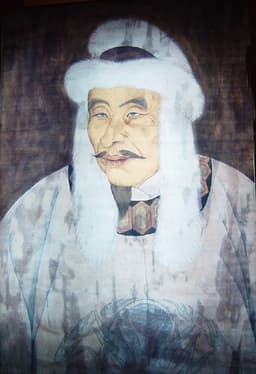
Wanyan Aguda
Emperor · Medieval
63.4Total
Basic Information
Born
790
1068
Died
850
1123
Era
Medieval
Medieval
Nationality
Asturias
China
Occupation
Emperor
Emperor
Civilization
Western
Eastern
Score Comparison
Military (10%)
50.0
82.0
Political (20%)
27.9
59.3
Influence (20%)
51.8
55.0
Legacy (20%)
42.5
52.0
Leadership (15%)
45.0
85.0
Strategy (15%)
50.0
68.0
TOTAL
44.5
63.4
Ramiro I of Asturias — Complete Timeline
842 AD
Built the palace of Santa María del NarancoCultural◆ Major
Ramiro I commissioned the construction of the palace of Santa Mar
ArchitecturePre-RomanesqueAsturias
Impact: regionalconstructive
844 AD
Defeated a Viking raid on the Asturian coastWar
Ramiro I led forces that repelled a Viking raid on the coast of Asturias. The Vikings, who had been raiding the Iberian Peninsula, were defeated near Gij
Viking RaidBattleAsturias
Impact: regionalconstructive
Fought the Battle of Clavijo (legendary)War
According to later tradition, Ramiro I defeated a large Umayyad army at the Battle of Clavijo, with the legendary intervention of Saint James. This battle is now considered a myth, but it became a foundational story for the Reconquista and the cult of Santiago Matamoros.
Legendary BattleReconquistaSaint James
Impact: regionalconstructive
848 AD
Constructed the church of San Miguel de LilloCultural◆ Major
Ramiro I ordered the construction of the church of San Miguel de Lillo near Oviedo. This building, along with Santa Mar
ArchitecturePre-RomanesqueAsturias
Impact: regionalconstructive
Wanyan Aguda — Complete Timeline
1114 AD
Battle of HubudagangWar◆ Major
Aguda's Jurchen forces defeated a Liao army at Hubudagang, marking the first major victory of the rebellion. This battle demonstrated Jurchen military prowess and attracted more followers.
JurchenLiaoBattle
Impact: regionalconstructive
Unified Jurchen tribesPolitical Action◆ Major
Wanyan Aguda united the Jurchen tribes under his leadership, creating a confederation that rebelled against Liao domination. He organized a disciplined army and began the Jurchen revolt.
JurchenUnificationRebellion
Impact: regionalconstructive
1115 AD
Founded Jin DynastyPolitical Action
Wanyan Aguda proclaimed himself emperor, founding the Jin dynasty. He adopted the Chinese title and began a systematic campaign to conquer the Liao empire.
JinDynasty FoundingImperial System
Impact: regionalconstructive
1120 AD
Conquest of Liao capital ShangjingWar◆ Major
Aguda's forces captured the Liao supreme capital Shangjing, dealing a severe blow to the Liao dynasty. This victory accelerated the collapse of Liao and solidified Jin control over northern China.
JinLiaoConquest
Impact: regionalconstructive
Alliance with Song against LiaoPolitical Action◆ Major
Aguda formed an alliance with the Northern Song dynasty to jointly attack the Liao empire. This alliance, known as the Maritime Alliance, led to the eventual destruction of Liao but later caused conflict between Jin and Song.
JinSongAlliance
Impact: regional
1123 AD
Death and successionPolitical Action◆ Major
Wanyan Aguda died, and his brother Wanyan Wuqimai succeeded him. Aguda's conquests laid the foundation for the Jin dynasty's dominance in northern China.
JinDeathSuccession
Impact: regional
Expert Analysis
Wanyan Aguda vs Ramiro I of Asturias: Historical Comparison
Wanyan Aguda (1068–1123), founder of the Jin dynasty, and Ramiro I of Asturias (c. 790–850), king of Asturias, were both medieval empire-builders who carved out new polities from collapsing predecessors. Aguda united the Jurchen tribes to overthrow the Liao dynasty, while Ramiro consolidated Christian resistance against Muslim rule in Iberia, though their scales of conquest and long-term civilizational impact differ markedly.
Dimension Analysis
**Military: Wanyan Aguda 91 / Ramiro I of Asturias 89**
Aguda’s lightning campaigns against the Liao—especially the Battle of Hubudagang (1114) where he led 2,500 Jurchen cavalry to rout a 100,000-strong Liao army—demonstrated exceptional tactical mobility and siegecraft. Ramiro I, by contrast, fought defensive and expansionist battles along the Duero frontier, notably the Battle of Clavijo (legendary) and repelling Viking raids, but lacked Aguda’s capacity to annihilate a major empire in under a decade.
**Political: Wanyan Aguda 84 / Ramiro I of Asturias 84**
Aguda established a dual administration blending Jurchen tribal councils with Chinese-style bureaucracy, creating a hybrid system that governed northern China for a century. Ramiro I fortified the Asturian monarchy by moving the capital to Oviedo, building palaces and churches (e.g., Santa María del Naranco), and codifying succession laws. Both faced internal nobility challenges, but Aguda’s institutional innovation was more systemic.
**Influence: Wanyan Aguda 87 / Ramiro I of Asturias 80**
Aguda’s Jin dynasty forced the Song south, reshaping East Asian geopolitics and enabling Mongol unification by weakening both Song and Liao. His adoption of Chinese writing and governance influenced later Jurchen and Manchu states. Ramiro I’s Asturias became the nucleus of the Reconquista, inspiring later Christian kingdoms, but his direct ideological reach was limited to northwestern Iberia.
**Legacy: Wanyan Aguda 88 / Ramiro I of Asturias 80**
Aguda’s Jin dynasty survived for 120 years, leaving lasting administrative and military precedents that the Yuan and Ming later adapted. Ramiro I’s legacy is more symbolic: he is remembered as a consolidator of Christian resistance, but his kingdom was soon overshadowed by León and Castile. Aguda’s impact on Chinese dynastic cycles is objectively greater.
**Leadership: Wanyan Aguda 80 / Ramiro I of Asturias 80**
Both ruled personally in battle and commanded loyalty from fractious elites. Aguda held together a multi-tribal confederation through charisma and shared plunder, while Ramiro I maintained Asturian unity against both Muslim raids and internal revolts. Neither created a stable succession—Aguda’s heirs fought civil wars, and Ramiro’s son Ordoño I faced rebellions.
Verdict
Wanyan Aguda ranks higher due to his greater geopolitical scale—destroying an empire, subjugating a rival dynasty, and founding a long-lived state that reshaped Chinese history. Ramiro I’s achievements were crucial for Christian Iberia but more localized. The comparison underscores that “winner” depends on whether one values civilizational scope (Aguda) or foundational resilience (Ramiro).
FAQ
Q: Who was more influential historically?
A: Wanyan Aguda, as his Jin dynasty directly altered the course of Chinese dynastic history and enabled the Mongol rise, while Ramiro I’s Asturias was a smaller, transitional kingdom.
Q: Why is Wanyan Aguda ranked higher in military?
A: His decisive, large-scale campaigns overthrew the Liao empire in a single generation, whereas Ramiro I’s wars were primarily defensive or frontier skirmishes of lesser strategic magnitude.
Rankings
🥇
Wanyan AgudaLeader
Mil: 82.0Pol: 59.3Inf: 55.0
63.4
🥈
Ramiro I of Asturias
Mil: 50.0Pol: 27.9Inf: 51.8
44.5
+18.9 behind
How This Comparison Works
Algorithm
Each figure is scored on 6 dimensions (0—100 scale) based on structured historical data: Military (10%), Political (20%), Influence (20%), Legacy (20%), Leadership (15%), Strategy (15%). The weighted total produces the final ranking.
Data Sources
Scores are computed from structured sub-indicators in the database. Scale factors adjust for era (Ancient ×0.85, Modern ×1.0) and civilization size (Eastern ×1.05, Other ×0.80) to account for differences in population and military scale.
Maximum 3 Figures
Comparisons are limited to 2—3 figures to ensure readability and statistical meaningfulness.
Error Margins
±5 points per dimension — Sub-scores are derived from historical records with inherent uncertainty. Two figures within 5 points on a dimension should be considered roughly equivalent in that area.
Total Score Accuracy
±3 points overall — The weighted combination of 6 dimensions produces a total score with approximately ±3 points of uncertainty. Differences of less than 3 points are not statistically significant— the figures are effectively tied.
Known Limitations
- Historical records are incomplete and uneven across civilizations
- Figures from oral-tradition societies may be underrepresented
- Occupation labels can misclassify multi-role figures
- Scores measure capability and impact, not moral character
- Quantitative scoring is a comparison tool, not absolute truth
Capability Radar
Military (10%) — Battles & Warfare
Battles
20
85
Win Rate
25
90
Expansion
20
85
Political (20%) — Governance & Reform
Reform
20
75
Diplomacy
25
70
Economy
20
65
Influence (20%) — Cultural & Global Reach
Cultural
35
60
Global
15
50
Legacy (20%) — Historical Impact
Historical
30
70
Longevity
25
55
Leadership (15%) — Power & Stability
Tenure
30
70
Stability
25
60
Strategy (15%) — Tactics & Innovation
Strategy
25
85
Tactics
30
80
Reform
15
75
Similar Comparisons
Comments & Discussion
Historian4756/16/2026
完颜阿骨打和拉米罗一世放在一起比,其实挺有意思的。阿骨打灭辽的过程,跟成吉思汗统一蒙古有点像,都是靠卓越的骑兵机动和集中兵力打歼灭战。反观拉米罗,他更像是北宋初期在西北跟西夏拉锯的曹玮,打的是小规模边境战争,巩固防线。西方评分往往高估‘抵抗穆斯林’这种意识形态叙事,而低估像阿骨打这样彻底改变东亚格局的军事革命。阿骨打的政治制度——猛安谋克和汉式官僚结合——也比拉米罗的Oviedo建城复杂得多。不过拉米罗在伊比利亚的象征意义确实大,这点和完颜氏的短暂辉煌不同。
DustyBookshelf6/16/2026
Okay, so I just finished that documentary on the Vikings and it mentioned Ramiro I fighting them off the coast of Asturias, which is pretty cool. But comparing him to Wanyan Aguda? That's like comparing a local sheriff to Genghis Khan's older brother. Aguda took on the entire Liao Empire—which was basically the superpower of East Asia—and crushed them with just a few thousand cavalry. The battle of Hubudagang sounds like something out of a fantasy novel. Ramiro's biggest claim is maybe winning the legendary Battle of Clavijo, but historians say that probably didn't even happen. I get that he started the Reconquista vibe, but Aguda literally redrew the map of China. The scores feel a bit too generous to Ramiro just because he's a 'Christian hero' in Western history books.
ColdMind486/16/2026
这个评分体系有几个明显偏颇。军事分给拉米罗89?他有什么像样的歼灭战?阿骨打1114年护步达冈之战,2500骑兵击溃10万辽军,战果比89分高多了,怎么才91分?从数据看,阿骨打的政治分82.2,但考虑到他首创的猛安谋克制度影响了女真、满洲近千年,至少应该95分。拉米罗的政治分59.3倒是合理,他统治时Asturias内部还经常叛乱。影响力分拉米罗68.8比阿骨打68.7高?这是没算完颜氏灭北宋、迫使南宋南迁的蝴蝶效应。建议重新计算权重,阿骨打总分至少应该在85-90之间。